Bitcoin drops 40%: Why analysts doubt an 80% crash

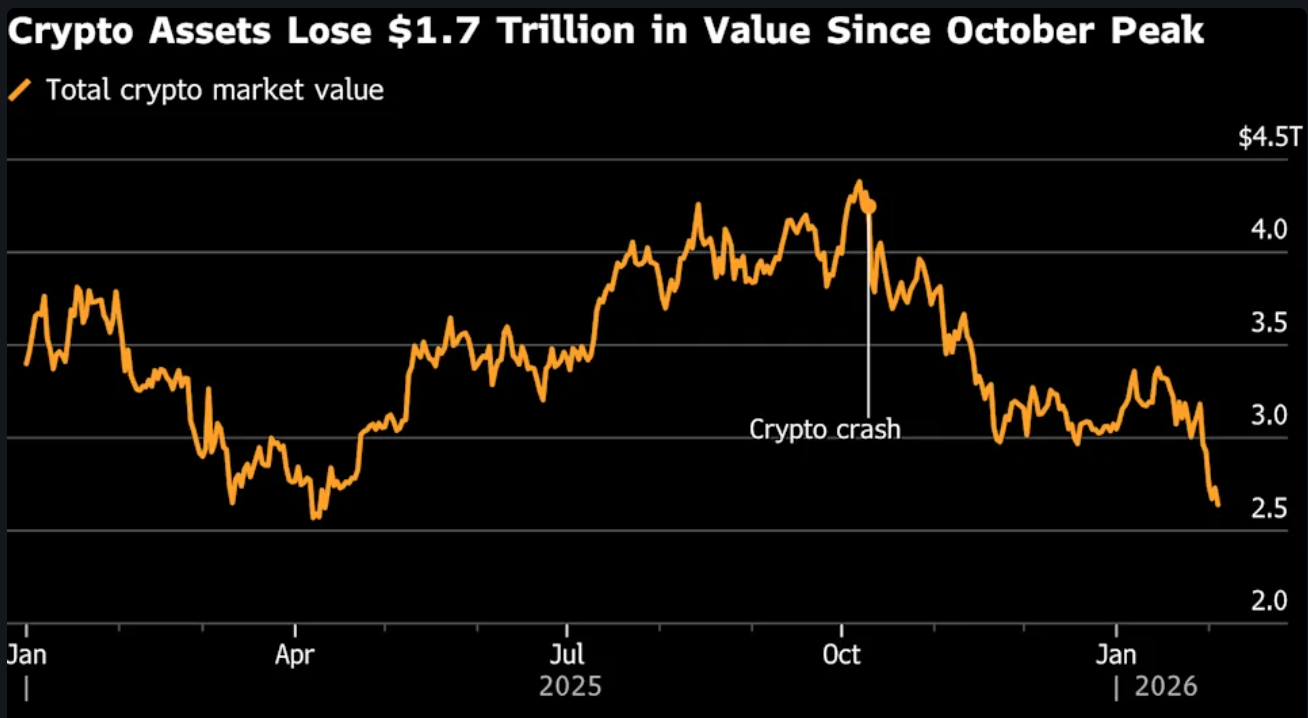
Bitcoin’s price has fallen roughly 40% from its October peak, rattling markets and reviving fears of another brutal crypto winter. The latest leg down included an 11% weekly loss as global markets flipped risk-off, dragging digital assets lower alongside volatile US equities. For many investors, the move feels uncomfortably familiar.
The concern centres on Bitcoin’s four-year cycle, which in past downturns delivered collapses of up to 80%. Yet analysts at K33 argue that today’s sell-off lacks the structural stress that defined previous crashes. With forced liquidations already flushed out and institutional buyers now entrenched, the question is no longer whether Bitcoin is falling - but whether this decline is a reset or the start of something far worse.
What’s driving Bitcoin’s latest sell-off?
Bitcoin’s decline has unfolded alongside a broader shift in global risk appetite. Equity markets have turned volatile again, with technology stocks leading losses as investors reassess growth expectations and valuation risk. Crypto, which has increasingly traded in sync with US equities, followed the same path as capital rotated toward safety.
Leverage has amplified the move. In just a few days, more than $1.7 billion in leveraged long positions were liquidated across crypto markets.
Funding rates flipped sharply negative, signalling that traders rushed to exit bullish calls. Historically, such conditions appear during periods of stress, but they also tend to surface after excessive optimism has already been wrung out of the market.
Why it matters
For newer investors, sharp drawdowns often trigger panic selling. Bitcoin’s past cycle crashes trained the market to expect catastrophic declines once momentum breaks. That behavioural memory alone can deepen sell-offs, even when underlying conditions differ.
K33’s analysts argue that this cycle lacks the forced sellers that defined 2018 and 2022. Those bear markets were driven by cascading failures - from Terra-Luna to FTX - that triggered margin calls and indiscriminate liquidation. “The structure that produced 80% crashes simply isn’t present today,” the firm noted in its latest report.
Impact on crypto markets and equities
The sell-off has spilled well beyond Bitcoin itself. Crypto-linked equities have suffered steep losses as investors reassessed exposure across the ecosystem. Strategy, the largest corporate holder of Bitcoin, fell more than 5% in a single session and is now down nearly 70% over six months.
Mining stocks were hit even harder. Companies that pivoted toward high-performance computing and AI infrastructure failed to escape the downturn. HUT 8 fell 8%, Core Scientific nearly 9%, and IREN plunged 17%. As Aurelie Barthere of Nansen observed, “The correlation between crypto and US equities is turning positive again as they sell off simultaneously,” reinforcing Bitcoin’s sensitivity to macro volatility.
Expert outlook
K33 identifies $74,000 as a key support zone. A clean break below it could open the door to a retest of the 2021 peak near $69,000, or even the long-term average around $58,000. While those levels appear daunting, analysts note that Bitcoin has already absorbed heavy liquidation pressure without systemic stress.
The presence of spot Bitcoin ETFs has quietly reshaped market dynamics. Pension funds and long-term allocators now account for a growing share of demand, dampening the reflexive selling seen in past cycles. The near-term path may remain volatile, but analysts increasingly frame this drawdown as a structural correction rather than a cycle-ending collapse.
Key takeaway
Bitcoin’s 40% decline has revived memories of past cycle crashes, but the market structure has changed meaningfully. Forced sellers are largely absent, leverage has already been flushed, and institutional demand is now embedded through ETFs. Volatility may persist, yet analysts increasingly view this drawdown as a reset rather than a collapse. The next signals to watch are ETF flows, equity market stability, and whether key support zones hold.
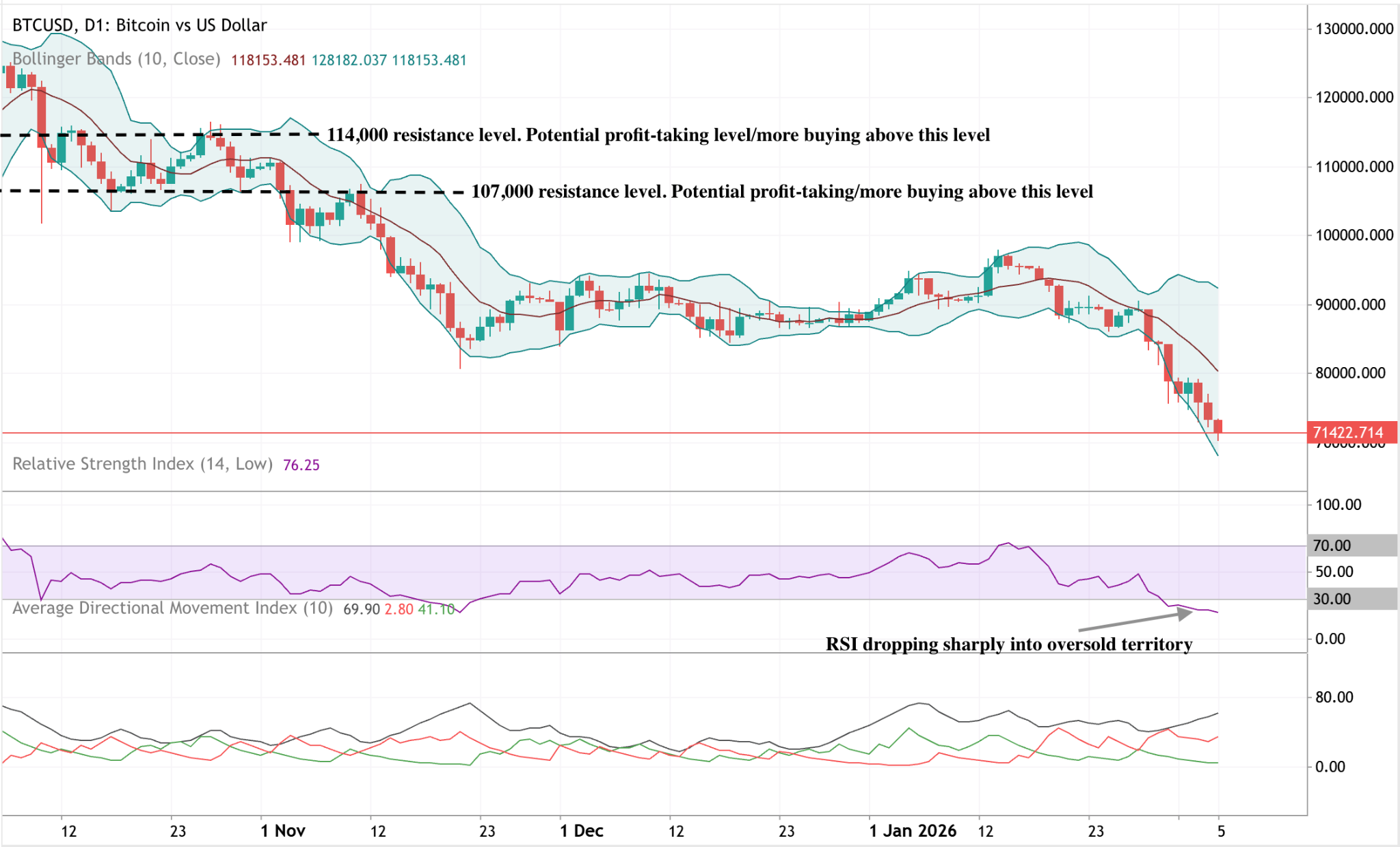
Bitcoin technical outlook
Bitcoin has extended its decline, moving further toward the lower end of its recent price range after breaking down from a prolonged consolidation. Price is trading below the lower Bollinger Band, while the bands remain widely expanded, reflecting elevated volatility and strong directional pressure following the recent acceleration lower. Momentum indicators show extreme conditions, with the RSI dropping sharply into oversold territory, signalling a rapid deterioration in short-term momentum rather than a gradual weakening.
Trend strength remains elevated, as indicated by high ADX readings, highlighting an active and mature trend environment despite the recent shift in direction. Structurally, price is now positioned well below the former consolidation area around $90,000, with earlier resistance zones near $107,000 and $114,000 far above current levels.