
The next test for Nvidia: can spending on artificial intelligence drive the stock higher?

Yes: continued spending on artificial intelligence could push Nvidia shares higher, but the easy gains are probably already a thing of the past, according to analysts. The next phase depends less on media hype and more on whether the major cloud service providers keep investing capital at scale—and on whether Nvidia can defend its profit margins as competition intensifies.
This question came up this week after Nvidia shares surged sharply, rising more than 8% in a single session. The catalyst wasn’t Nvidia’s own earnings, but Amazon’s forecast of capital spending close to $200 billion for 2025, a significant portion of which is earmarked for AI infrastructure. For investors, it was a reminder that the AI buildout remains very real, even as valuations face stricter scrutiny.
What’s driving Nvidia now?
Amazon’s spending guidance arrived at a crucial moment for Nvidia. Earlier in the week, the stock was under pressure as investors reassessed lofty tech valuations after a broad market sell-off. Amazon’s forecast reversed that weakness. A $200 billion capex plan doesn’t signal caution—it signals acceleration. Nvidia remains the primary supplier of high-performance GPUs that power large AI data centers, making it a direct beneficiary of this spending.
The market reaction revealed where investor confidence really lies. Amazon shares fell on disappointing results, while Nvidia jumped. This contrast highlights Nvidia’s unique position in the AI ecosystem. Demand for computing is no longer theoretical or “future”—it is now embedded in current budgets, multi-year contracts, and strategic infrastructure decisions that are difficult to unwind once made.
Why this matters for Nvidia’s valuation
Nvidia’s valuation has become the central battleground. Since ChatGPT launched in late 2022, Nvidia has delivered results that beat expectations quarter after quarter, driven by explosive AI demand. That success has put the stock in most institutional and retail portfolios, leaving less new capital on the sidelines to automatically push the stock higher.
CEO Jensen Huang addressed this tension directly, calling the recent drop in tech stocks “irrational.” And while such statements naturally reflect leadership optimism, Huang’s comments have consistently carried weight in markets. Investors seem to interpret his stance as a signal that current valuations still reflect real earnings strength—not just excessive speculation.
Impact on the AI and semiconductor landscape
Nvidia’s rally has implications beyond a single stock. It reinforces the idea that AI spending is increasingly concentrating among a small group of large buyers rather than disappearing altogether. Amazon, Microsoft, and Google aren’t cutting their AI budgets—they’re expanding them.
For the semiconductor industry, this concentration benefits Nvidia. Its competitive advantage goes beyond hardware and includes software, networking, and developer environments, which makes switching costs high. While AMD and Broadcom are making progress, Nvidia’s integrated platform remains difficult to replicate at scale. This insulation gives Nvidia more pricing power than most competitors—at least in the short term.
Expert outlook: where the real test is
All eyes are now on Nvidia’s next earnings report on February 25. Goldman Sachs expects the company to beat revenue by about $2 billion for fiscal Q4, projecting $67.3 billion in revenue and earnings above consensus. The bank also expects Nvidia to beat market estimates for the following quarter.
However, Goldman struck a cautious tone. With expectations already elevated, investor focus may shift from short-term results to Nvidia’s guidance for 2026 and 2027. In other words, the market is less interested in how strong AI demand was in the past and more focused on Nvidia’s ability to sustain growth without margin erosion as competition intensifies.
Key takeaway
AI spending can still lift Nvidia, but the market’s tolerance for disappointment is shrinking. Amazon’s $200 billion capex plan reaffirmed Nvidia’s central role in the AI economy, supporting near-term optimism. However, the stock’s next move will depend less on demand headlines and more on long-term guidance and margin resilience. The test for Nvidia is no longer whether AI is real—it’s whether dominance can be sustained.
Nvidia technical outlook
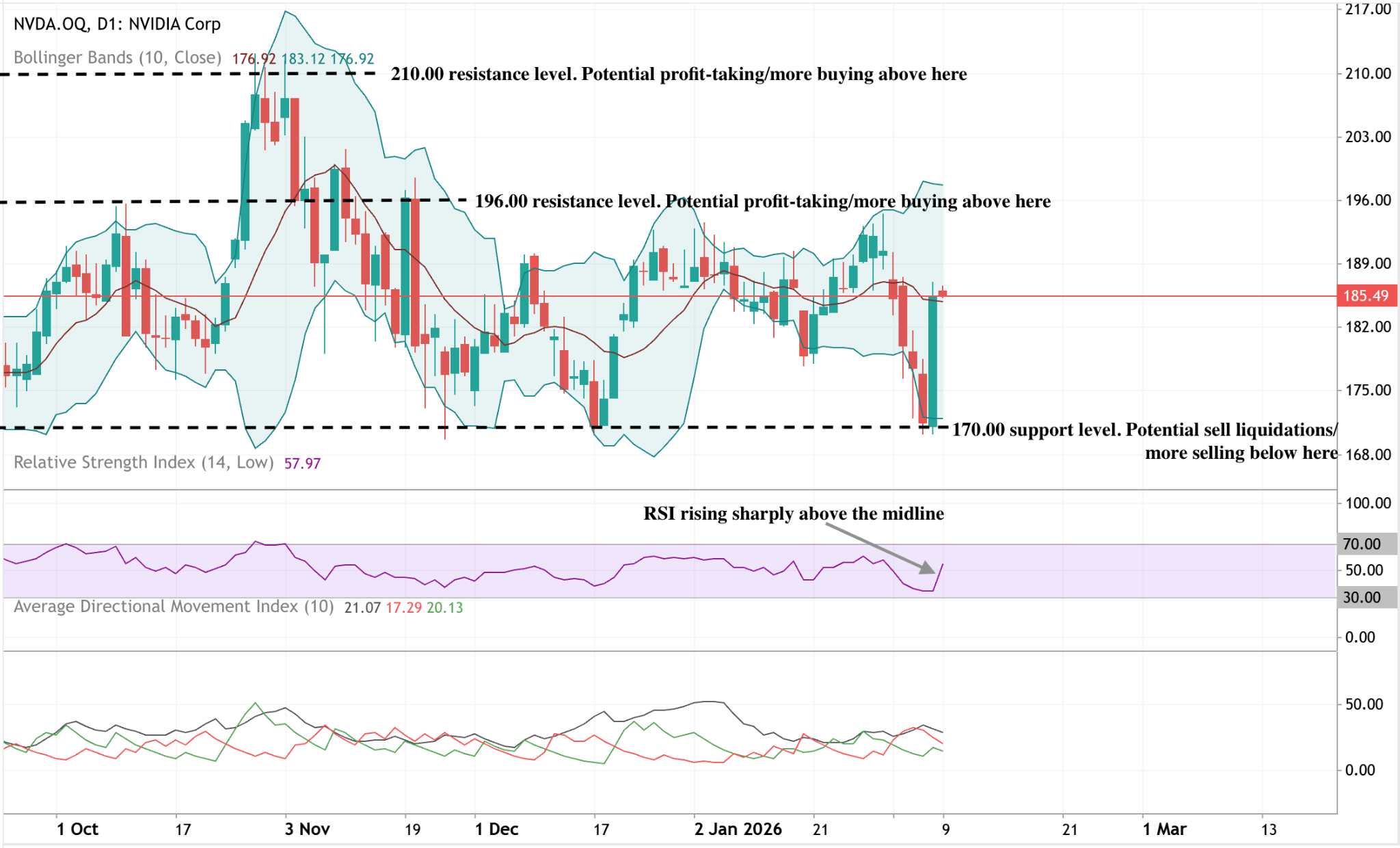
Nvidia continues to trade within a wide consolidation range after prior volatility, with the price fluctuating between support near $170 and upper areas around $196 and $210. The Bollinger Bands show moderate expansion compared with the prior squeeze, indicating rising volatility without a sustained directional move. Momentum indicators show a short-term rebound, with a strong RSI recovery above the midline after a recent drop, reflecting a bounce from weaker conditions rather than trend acceleration. Trend strength remains weak, as ADX readings stay relatively low, pointing to limited directional dominance.
The performance mentioned does not guarantee future results.


