
The 2025 scorecard: Bitcoin, Gold and Silver’s biggest calls

Every market cycle produces its prophets.
Some sound the alarm early. Some ride the wave all the way up. Others dig their heels in, convinced the market is wrong-right until it proves them so.
Looking back, 2025 wasn’t short on conviction. Bitcoin tore through psychological ceilings. Gold rewrote the record books. Silver finally stopped playing second fiddle. And all along the way, analysts, economists, fund managers and Twitter sages were staking their reputations on what came next.
This is not a victory lap - nor a pile-on. It’s a clear-eyed look at the voices that shaped the narrative, the calls that aged well, and the ones that struggled as reality unfolded.
Bitcoin: the great divide widened
Eugene Fama - intellectually consistent, market-defiant
If Bitcoin had a chief sceptic-in-residence this year, it was Eugene Fama.
Long before Bitcoin climbed into the trillion-dollar club, the Nobel Prize-winning economist had already delivered his verdict. In conversations earlier in the cycle, Fama argued that Bitcoin violated the basic rules of money, no stable value, no intrinsic anchor, no reason to survive in the long run.
He went further than most, assigning Bitcoin a “close to 100% probability” of becoming worthless within a decade.
From a 2025 vantage point, the market didn’t just disagree - it steamrolled past him.
Bitcoin surged beyond $100,000, institutional adoption accelerated, spot ETFs rewired access, and regulators - once seen as existential threats - began laying out red carpets instead of roadblocks.
And yet, Fama wasn’t really “wrong” in the way markets usually mean it.
His critique wasn’t about price - it was about the definition of money itself. If Bitcoin survives, he argued, then monetary theory must change with it. In that sense, 2025 didn’t disprove Fama. It simply postponed the reckoning he believes is inevitable.
The market voted with capital. The theory remains unresolved.
Tom Lee - momentum, timing, and conviction rewarded
If Fama represented academic resistance, Tom Lee embodied market instinct.
Lee had already earned credibility by calling the S&P 500 rebound almost to the point. When he turned that confidence toward Bitcoin - projecting $100,000 as a base case - many dismissed it as ETF hype.
They shouldn’t have.
By August 2025, Bitcoin not only cleared that level, it held it. Lee’s thesis was brutally simple and, in hindsight, brutally effective:
- ETFs opened the floodgates
- Supply tightened after the halving
- Rates eased, and risk appetite followed
Lee even warned that volatility would shake out weak hands - flagging the possibility of sharp pullbacks before any sustained run higher. That nuance mattered. Bitcoin did wobble. Conviction was rewarded. Hesitation was punished.
In a year full of bold forecasts, Lee’s stood out because the market behaved exactly as his framework suggested.
Jon Glover and the technicians - right on timing, early on finality
Then there were the technicians.
Ledn’s Jon Glover, leaning on Elliott Wave theory, called Bitcoin’s surge toward $125,000 with impressive precision - just as sentiment elsewhere began to wobble. That call aged well.
Where it became contentious was the follow-through.
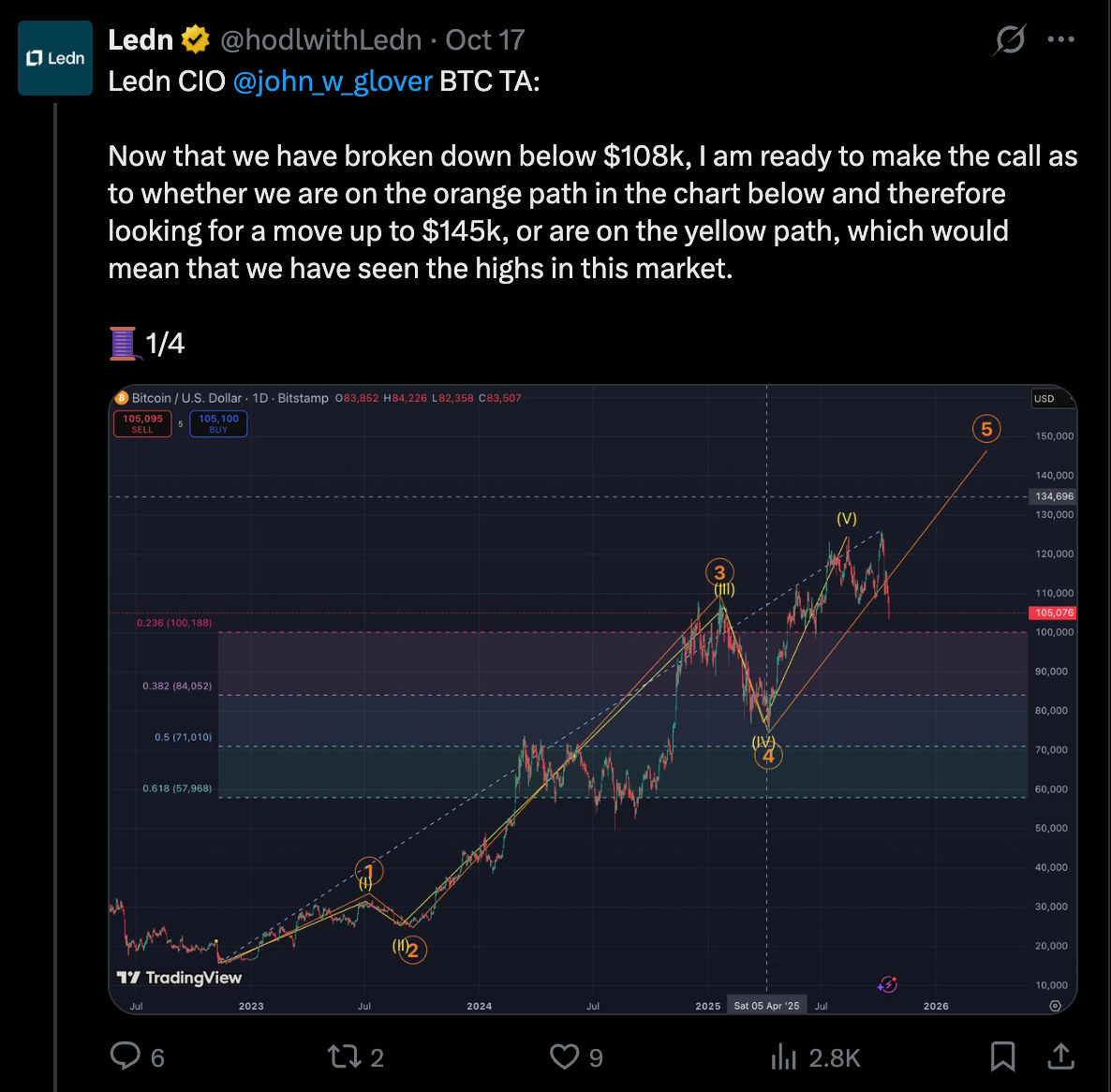
Alt text: A screenshot of a post from Ledn on X (formerly Twitter), dated October 17, quoting Ledn CIO John W. Glover’s Bitcoin technical analysis.
Source: X
Declaring the bull market “over” after the pullback felt decisive - perhaps too decisive.
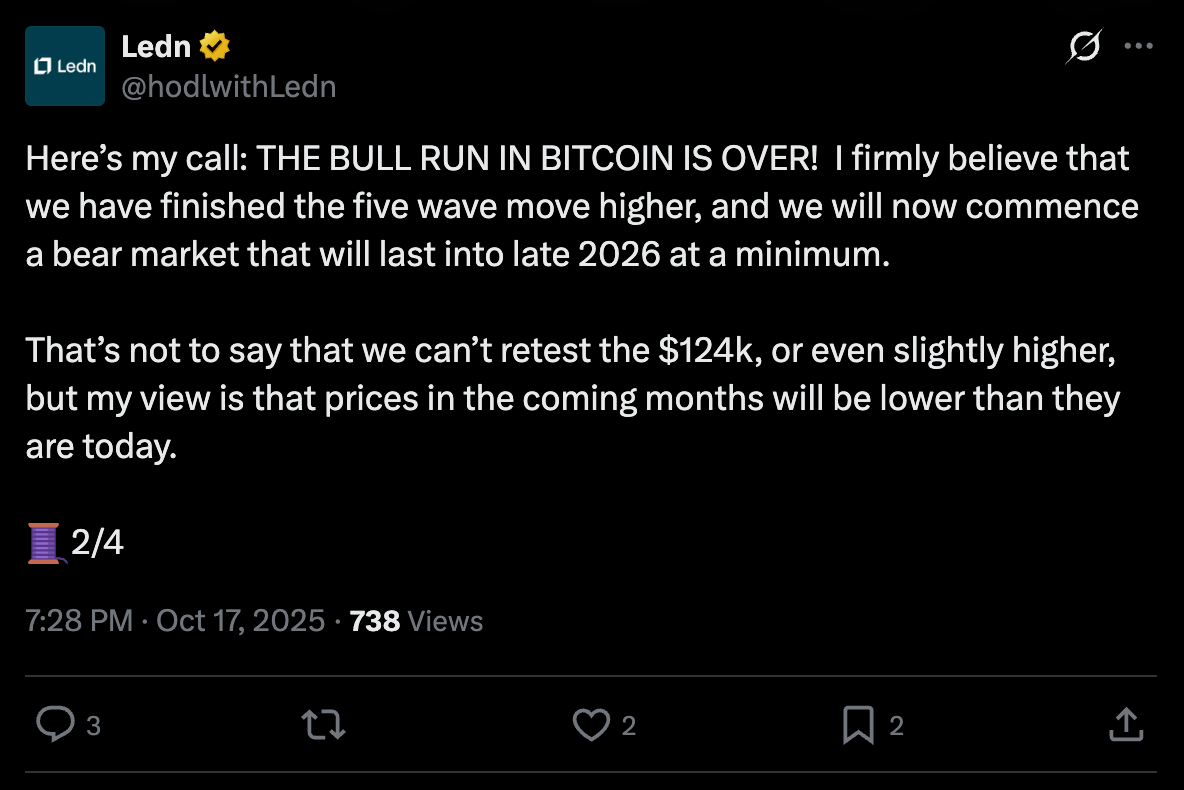
Alt text: A screenshot of a post from Ledn on X (formerly Twitter) by the account @hodlwithLedn.
Source: X
Yes, Bitcoin corrected. Yes, volatility returned. But broader adoption trends, ETF inflows and regulatory tailwinds refused to collapse alongside price.
2025 reminded traders of an old lesson: cycles bend, but narratives don’t always break.
Gold: the quiet winner that stopped whispering
Gold entered 2025 already strong. It ended the year with undeniable.
Voices like Maria Smirnova and Rick Rule had been arguing for years that gold’s rise wasn’t speculative - it was structural. Central banks weren’t buying headlines; they were buying insurance. Eastern demand wasn’t fleeting; it was a cultural phenomenon. And fiat erosion wasn’t theoretical - it was lived.
When gold pushed beyond $3,000 and continued to rise, the disbelief faded.
Critically, analysts who framed gold purely as a crisis hedge missed the broader shift. This wasn’t panic buying. It was balance-sheet management - from sovereigns to households.
Rick Rule’s blunt arithmetic landed hardest in hindsight: when inflation quietly outpaces yields, owning nothing but paper becomes a guaranteed loss. Gold didn’t need to “replace” the dollar. It simply needed to reclaim its historical share of global portfolios.
That reversion began in earnest this year.
The miners lagged, and then they didn’t
Sceptics mocked gold equities early on. Why weren’t miners exploding if gold was at record highs?
The answer, as Rule pointed out at the time, was simple: central banks buy bullion, not mining shares.
But as margins stabilised, discipline improved, and free cash flow surged, the disconnect began to close. By the second half of the year, the re-rating was underway - quietly, methodically, without the mania of past cycles.
Those who waited for headlines missed the move.
Silver: from perpetual underdog to reluctant star
Silver spent years trapped in explanation mode. Industrial metal. Monetary metal. Not quite gold. Not quite copper.
In 2025, it finally stopped apologising.
Banks like Citigroup raised forecasts aggressively, calling for silver to outperform gold - and the logic held. Investment demand surged. ETF holdings climbed. Industrial consumption, driven by solar and electrification, refused to slow.
The gold-to-silver ratio compressed sharply, just as analysts had suggested it would once capital rotated downstream.
Veterans like Smirnova had long argued that silver bull markets don’t announce themselves - they accelerate. That pattern re-emerged. Slowly at first. Then suddenly.
Those still waiting for a perfect supply narrative missed the point. Silver didn’t need scarcity headlines. It needed sustained demand - and it got it.
Key takeaway
If 2025 taught markets anything, it was this:
- Price doesn’t wait for consensus
- Narratives age faster than capital flows
- Being early is only useful if you stay solvent long enough to be right
Some voices were vindicated by price. Others by principle. A few by sheer timing.
And perhaps the real lesson of the year wasn’t about who was right or wrong - but about how markets reward conviction only when it’s paired with adaptability.
As Bitcoin, gold and silver roll into the next chapter, one thing is certain:
The next year-ender will have just as many confident voices.
The market will decide - again - which ones it listens to.
The performance figures quoted are not a guarantee of future performance.


