
Bitcoin’s $95K test: Breakout or false dawn?

Bitcoin’s push above $95,000 looks impressive, but this rally is best viewed as a conditional breakout rather than a clean escape. Prices have surged on easing US inflation and improving global liquidity, yet one crucial ingredient remains missing: strong US demand. Without it, the move risks stalling rather than accelerating.
That tension sits at the heart of the current market. Global investors are buying into the macro narrative, while derivatives traders are being forced out of bearish positions; however, American spot participation remains subdued. Whether Bitcoin can turn this surge into a sustained trend now depends less on momentum and more on who steps in next.
What’s driving Bitcoin’s latest move?
The immediate catalyst came from cooler-than-expected US inflation data, which reinforced expectations that the Federal Reserve will continue cutting rates this year. Lower inflation eased pressure on Treasury yields and loosened financial conditions - a combination that has historically supported Bitcoin and other risk assets.
Political uncertainty amplified the reaction. Reports that the US Justice Department issued grand jury subpoenas linked to the Federal Reserve unsettled markets and weakened the dollar. That pushed investors towards assets perceived as insulated from central-bank risk. Bitcoin rose more than 4% in response, while ether, solana, and cardano jumped between 7% and 9% in a single session.
Why it matters
US demand has historically been the key factor in determining whether temporary rallies or lasting bull phases emerge. When American capital engages, price strength tends to persist. When it does not, upside moves often rely on leverage and overseas flows, making them more fragile.
According to Singapore-based crypto exchange Phemex, a negative Coinbase premium indicates “strong selling pressure and potential capital outflows from the US market”.
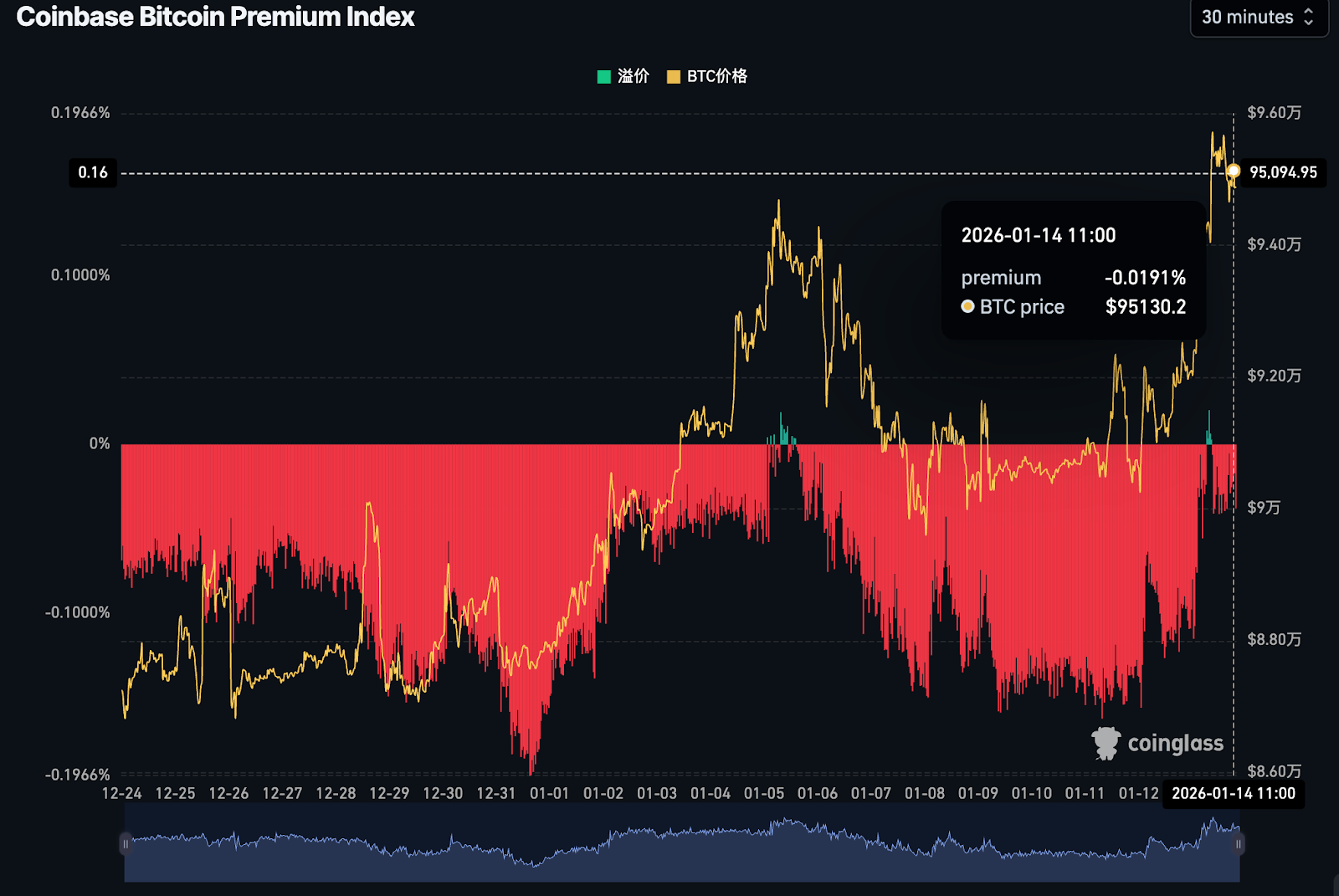
That warning is significant because the premium turned negative shortly after the US election in November 2024 and has largely remained there, even as Bitcoin’s price climbed.
One explanation lies in regulation. US investors appear to be waiting for the Clarity Act, proposed legislation aimed at clarifying crypto oversight. The Senate delayed a crucial markup until late January to secure bipartisan backing, keeping institutional investors cautious despite favourable macro conditions.
Impact on crypto markets
The rally has already reshaped positioning. More than $688 million in crypto derivatives positions were liquidated in a single day, with short sellers accounting for roughly $603 million of that total. Nearly 122,000 traders were wiped out as prices surged sharply.

That wave of forced buying helped propel Bitcoin past $95,000, but it also quickly rebuilt leverage. Open interest has risen as prices approach levels that previously triggered heavy selling. This combination - rising leverage near resistance - increases the likelihood of sharp, two-way volatility.
Beyond crypto, the broader market backdrop supports risk-taking. Asian equities have reached record highs, silver has broken above $90 an ounce, and gold is hovering just below all-time highs. Investors are increasingly positioning for looser financial conditions and currency instability rather than defensive outcomes.
Expert outlook
Most analysts agree that Bitcoin’s broader trend remains constructive, but the quality of the rally is now under scrutiny. Without renewed US spot demand, price gains may struggle to extend sustainably, even if global liquidity continues to improve.
Several strategists argue that approval of the Clarity Act could act as a release valve for sidelined US capital, potentially pushing Bitcoin towards fresh record highs. Until then, the market remains vulnerable to pullbacks driven by unwinds of leverage rather than fundamental shifts.
In short, Bitcoin is moving higher - but it is not yet being embraced by its most influential buyer base.
Key takeaway
Bitcoin’s surge above $95,000 reflects improving macroeconomic conditions and a global risk appetite, but it falls short of a decisive breakout. The absence of strong US demand leaves the rally dependent on offshore flows and leverage rather than conviction. Whether this move becomes the foundation for new highs or fades into consolidation will depend on regulation, spot inflows, and how the market handles rising leverage. The next signal to watch is not price, but participation.
Bitcoin technical outlook
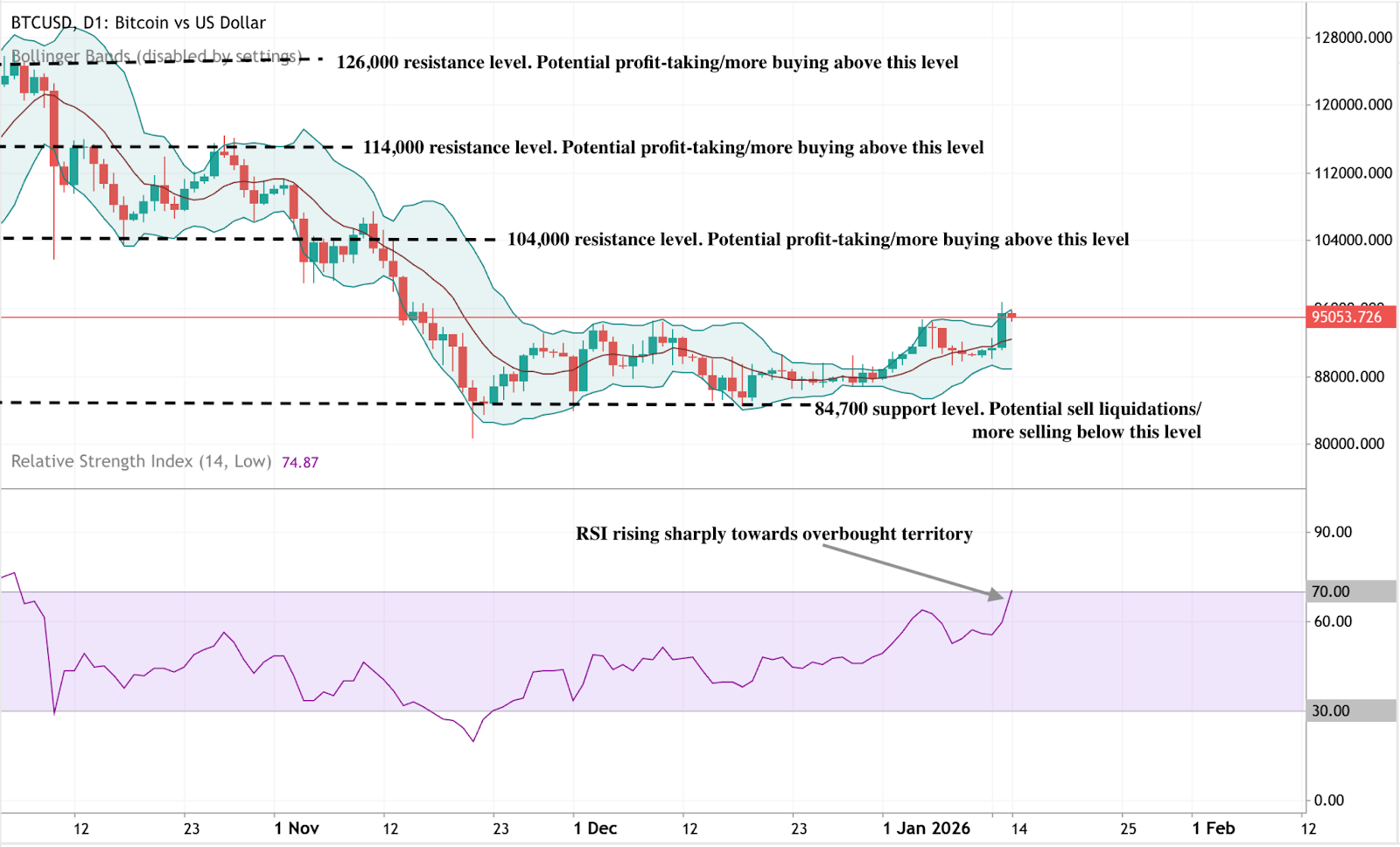
Bitcoin is attempting to reassert bullish momentum after holding above the $84,700 support zone, with price now pushing back toward the $95,000 area. The rebound has lifted RSI sharply toward overbought territory, signalling strong short-term momentum but also raising the risk of near-term profit-taking.
Structurally, the broader recovery remains intact as long as BTC holds above $84,700; however, upside progress is likely to face resistance at $104,000, followed by $114,000 and $ 126,000. Sustained acceptance above current levels would support further upside, while failure to hold gains would keep Bitcoin range-bound rather than confirm a renewed trend higher.
The performance figures quoted are not a guarantee of future performance.


