
Why Tesla’s record high is built on fragile foundations
%20(1)%20(1).png)
Tesla’s share price has pushed into record territory, but the foundations supporting that rally look increasingly unstable. Despite the stock climbing more than 20% this year, the company’s core electric vehicle business is shrinking, margins remain under pressure, and regulatory risks are rising rather than fading, according to reports.
The latest warning comes from California, where regulators are threatening a 30-day sales ban unless Tesla changes how it markets Autopilot and Full Self-Driving. At the same time, investors are valuing Tesla less like a carmaker and more like an AI and robotics company. That disconnect explains the rally - and why it may prove difficult to sustain.
What’s driving Tesla’s record high?
Analysts expressed that Tesla’s surge is being driven by belief, not balance sheets. Investors are once again buying into Elon Musk’s long-promised vision that Tesla will reinvent itself as a robotaxi and robotics platform. That optimism flared after Musk said Tesla has been testing fully driverless vehicles in Austin without safety drivers, a step bulls see as the beginning of large-scale autonomy.
Crucially, this enthusiasm has emerged even as Tesla’s underlying business is weakening. CNBC reported vehicle deliveries fell 13% in the first quarter, while automotive revenue dropped 20%. Sales stabilised briefly in the third quarter as US buyers rushed to secure expiring tax credits, but momentum faded once incentives disappeared. The stock, however, continued to climb - a sign that the market is pricing Tesla for what it hopes the company will become, not what it currently is.
Why it matters
California’s intervention strikes directly at that hope-driven valuation, according to analysts. The state’s Department of Motor Vehicles ruled that Tesla misled consumers by using terms such as “Autopilot” and “Full Self-Driving Capability” for systems that are not autonomous. Tesla now has 60 days to change its language or face a temporary suspension of sales in the state.
For investors, this is more than a branding dispute. California is Tesla’s largest US market and home to one of its factories. More importantly, regulatory credibility underpins Tesla’s entire autonomy narrative. According to one US auto analyst, “You cannot build a trillion-dollar autonomy business while regulators are questioning whether your product does what it says on the tin.”
Impact on the EV and AI trade
The regulatory pressure comes as Tesla faces intensifying competition and fading pricing power. CNBC reported that cheaper EVs from BYD and Xiaomi in China, alongside stronger European offerings from Volkswagen, are putting pressure on demand. In the US, stripped-down versions of the Model 3 and Model Y have cannibalised higher-margin models, pushing November sales to a four-year low.
In other news, Tesla’s stock also trades increasingly in lockstep with the broader AI sector. This week’s pullback followed weakness across AI-linked stocks after delays in Oracle’s massive data-centre financing raised concerns about the pace of AI infrastructure spending. That linkage makes Tesla more vulnerable to shifts in AI sentiment, even when its own fundamentals remain unchanged.
Expert outlook
Wall Street remains divided. Mizuho recently raised its price target on Tesla to $530, citing improvements in Full Self-Driving (Supervised) as a potential driver of robotaxi expansion in Austin and San Francisco. Bulls believe Tesla’s camera-only approach will scale faster and cheaper than rivals relying on lidar.
Sceptics see mounting legal and regulatory risks. Federal safety agencies continue to investigate crashes linked to Autopilot, while a Florida jury recently ordered Tesla to pay $329 million in damages following a fatal 2019 accident. Meanwhile, rivals such as Nissan, working with Nvidia-backed Wayve, are targeting similar driver-assist capabilities at half Tesla’s price. The technological lead Tesla once enjoyed is narrowing.
Key takeaway
Market watchers noted Tesla’s record high reflects belief in a future that has yet to arrive. Robotaxi optimism is masking weakening EV fundamentals and rising regulatory risk. California’s warning highlights how fragile that narrative has become. Investors should monitor regulatory outcomes, progress on real-world autonomy, and whether revenues can begin to justify the valuation.
Tesla technical insights
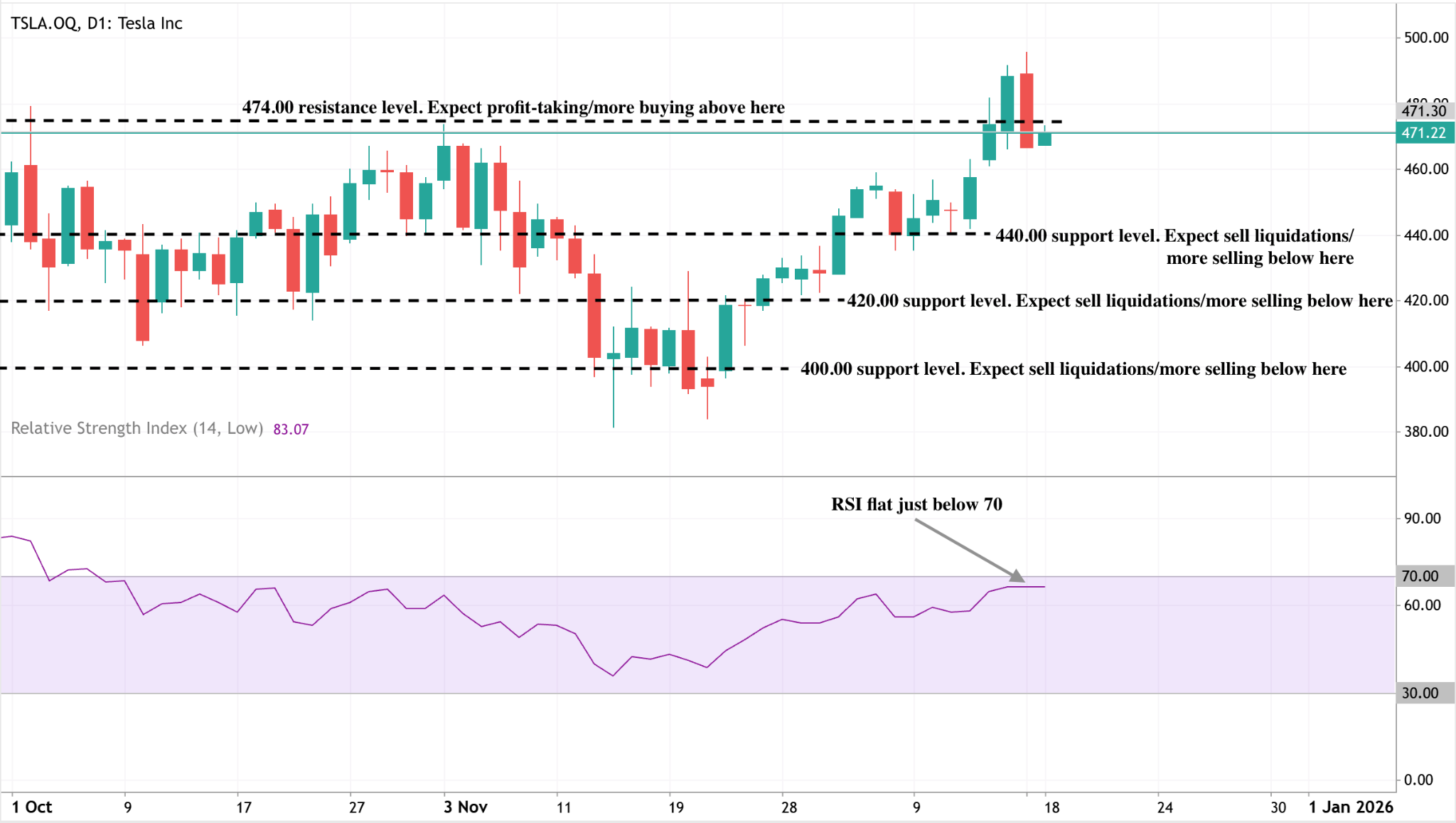
Tesla’s daily chart shows price consolidating just below a key $474 resistance zone, an area that has repeatedly capped upside moves. The recent rejection from this level suggests near-term profit-taking, although sustained buying above $474 would open the door for another momentum-driven push higher.
On the downside, $440 remains the first critical support, followed by $420 and the broader $400 demand zone. A clean break below $440 would likely trigger sell-side liquidity, increasing the risk of a deeper pullback towards these lower levels.
Momentum indicators suggest a market that is strong but overextended. The RSI is flattening just below the 70 mark, signalling bullish momentum is intact, but also warning that upside may be limited without fresh catalysts. This setup favours range-bound price action in the short term unless bulls can reclaim and hold above resistance.
The performance figures quoted are not a guarantee of future performance.


