
What the tech sell-off means for the next move in US Indices

The latest tech-led sell-off suggests US stock indices are entering a more fragile phase, where leadership can no longer be taken for granted. On Tuesday, the Nasdaq Composite dropped 1.4%, dragging the S&P 500 down 0.8%, as investors began questioning whether the AI-driven rally still justifies current valuations.
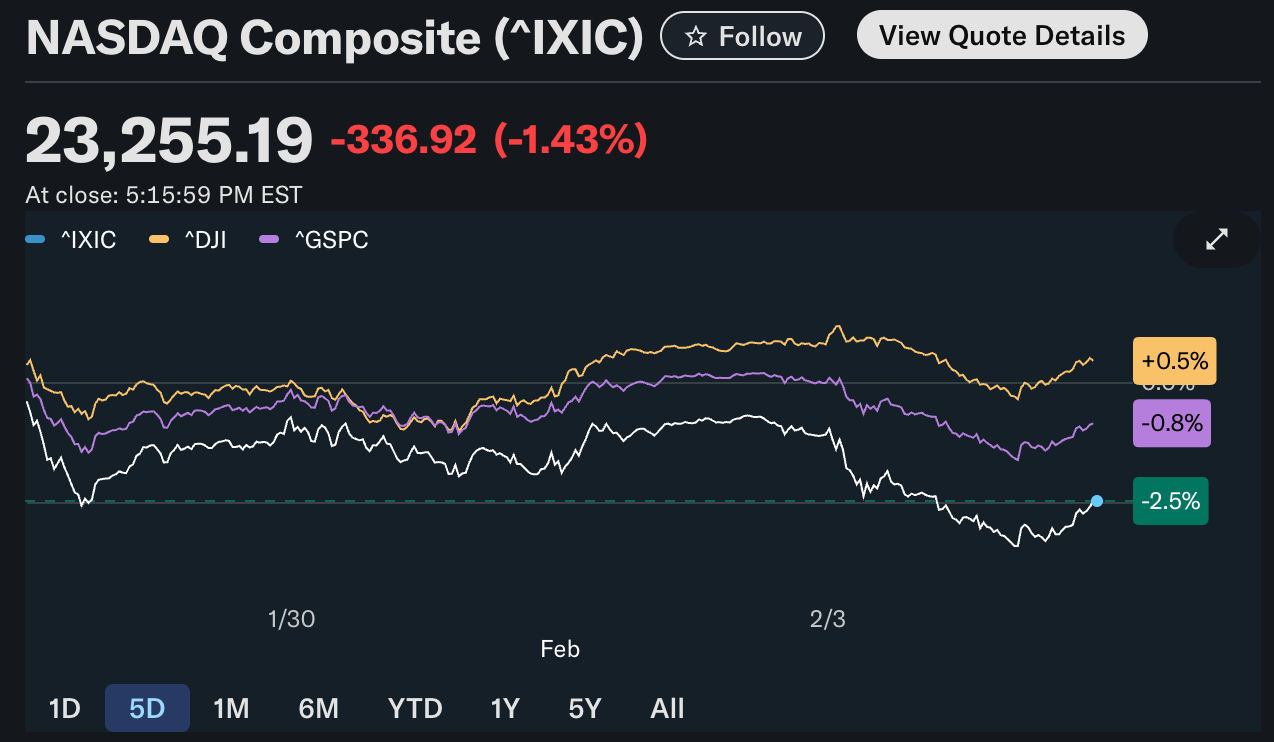
Rather than signalling a full trend reversal, the move suggests the market is recalibrating expectations. With earnings pressure building and volatility spilling into other assets, the next move for US indices will depend on whether Big Tech can restore confidence or whether investors continue to rotate away from crowded growth trades.
What’s driving the tech sell-off?
The immediate catalyst was renewed unease about the sustainability of AI spending. While Palantir’s upbeat earnings reinforced the long-term AI narrative, they failed to offset broader concerns about capital intensity and diminishing marginal returns across the sector. Nvidia’s nearly 3% decline proved particularly influential after reports suggested cooling relations with OpenAI, which has reportedly raised concerns over the performance of Nvidia’s latest AI chips.
That anxiety spread quickly across the software and cloud landscape. Amazon and Microsoft extended recent losses as investors continued to unwind positions in high-multiple names. The launch of a legal productivity tool by AI firm Anthropic added to the pressure, reinforcing fears that faster innovation may accelerate competition rather than protect margins. In this environment, markets are no longer rewarding AI exposure indiscriminately - they are demanding proof of profitability.
Why it matters for US Indices
US indices have become increasingly sensitive to movements in a small cluster of mega-cap technology stocks. The largest technology firms now represent over 30% of the S&P 500’s total market capitalisation, leaving benchmarks exposed when sentiment turns against the sector. When leadership falters, index-level resilience weakens quickly.
According to one US equity strategist, “The issue isn’t belief in AI - it’s whether earnings growth can keep pace with expectations priced into these stocks”. That distinction explains why markets can sell off even amid strong headline results. For indices, the risk lies not in a collapse, but in a prolonged period of uneven performance.
Impact on Markets and Investors
The sell-off has already triggered a visible shift in positioning. While equities retreated, investors rotated into defensive assets, pushing gold up more than 6% in a single session - its largest daily gain since 2008 - after suffering its steepest one-day drop in over 40 years just days earlier. Silver followed with a sharp 9% rebound, driven by aggressive dip-buying.
This divergence suggests investors are reducing exposure to momentum trades rather than abandoning risk entirely. Equity weakness alongside strength in precious metals points to hedging behaviour, not panic. For traders, it reflects a market preparing for more two-way price action, where rallies may face quicker resistance and pullbacks attract selective buying.
Expert outlook
The next directional move for US indices will be shaped by upcoming earnings from AMD, Amazon, and Alphabet, which are expected to provide clearer insight into AI-related spending, margins, and demand visibility. AMD’s results, in particular, are being viewed as a litmus test for whether competition in AI chips can support sector-wide growth rather than dilute returns.
Strategists remain cautious but not outright bearish. Most expect higher volatility as markets transition from narrative-driven optimism to earnings-driven scrutiny. If Big Tech can demonstrate operational discipline alongside growth, indices may stabilise. If not, US equities could enter a broader consolidation phase, marked by rotations rather than sustained upside.
Key takeaway
The tech sell-off signals a shift in how markets price growth, not a rejection of it. US indices remain supported, but leadership is under pressure amid investor demand for earnings discipline. The sharp move into gold highlights rising caution beneath the surface. The next phase will be defined by earnings credibility - and whether Big Tech can justify its outsized influence on the market.


