
Gold outlook: Can XAU/USD regain momentum after the pullback?

Gold’s failure to break above the $4,500 mark has prompted a natural question across markets: is XAU/USD simply catching its breath, or has the rally finally run out of steam? Reports suggest that prices have slipped back towards the $4,430–$4,450 area after a strong advance from November lows, as traders locked in profits and the US dollar showed modest signs of recovery.
So far, the evidence points to consolidation rather than capitulation. Data suggests that US job openings have dropped to 7.15 million, private payroll growth slowed to just 41,000, and markets are still pricing roughly 60 basis points of Federal Reserve rate cuts this year. With Nonfarm Payrolls looming and geopolitics unresolved, gold’s next move will hinge on whether these forces can reignite upside momentum.
What’s driving gold right now?
The immediate drag on gold has come from positioning rather than panic. After stalling near $4,500 - a level that has repeatedly capped rallies - traders began trimming exposure following weeks of gains. That selling coincided with a firmer US dollar, supported by better-than-expected US services data.
The ISM Services index rose to 54.4 in December, its strongest reading since October, suggesting pockets of resilience in the US economy.

Yet beneath the surface, the labour market is clearly cooling. Job openings declined by more than 300,000 in November, and private-sector hiring fell short of expectations for a second consecutive month. These figures reinforce the view that US growth is slowing gradually rather than reaccelerating, keeping Federal Reserve easing expectations intact. For gold, this balance has created a holding pattern, pressured by the dollar in the short term but supported by a softer macroeconomic trajectory.
Why it matters
This distinction between tactical selling and a shift in fundamentals is critical. Gold’s pullback has not been accompanied by a surge in real yields or a sharp repricing of Fed expectations. Instead, it reflects investors’ banking profits after a sharp rally.
David Meger, director of metals trading at High Ridge Futures, described the move as “general profit-taking after that recent surge,” rather than the start of a broader unwind.
Longer-term demand signals remain constructive. Central banks continue to provide a steady bid, with China extending its gold-buying streak to 14 consecutive months in December. At the same time, futures markets still imply more than two quarter-point rate cuts this year. That combination keeps the strategic case for gold intact, even as short-term momentum softens.
Impact on the gold market and traders
Beyond macro data, technical and flow-driven forces are now influencing price action. According to reports, Gold faces near-term headwinds from the Bloomberg Commodity Index’s annual January rebalancing, which will reduce gold’s weighting from 20.4% to 14.9% to comply with diversification limits.
Deutsche Bank estimates that this could trigger the sale of around 2.4 million troy ounces of gold over a five-day window, potentially resulting in a 2.5–3% price impact.
That said, history suggests these flows do not guarantee sustained downside. In several past rebalancing cycles, price movements aligned with weighting changes; however, last year proved an exception, as gold rose despite a reduction in index exposure. For traders, this creates a market where short-term volatility may increase, but where dips could still attract buyers if macro and geopolitical support holds.
Expert outlook
The next decisive test for gold comes with Friday’s US Nonfarm Payrolls report. Consensus forecasts indicate approximately 60,000 new jobs in December, with the unemployment rate expected to edge down to 4.5%.
A weaker-than-expected print would likely reinforce rate-cut expectations, weigh on the dollar, and give gold scope to regain upside momentum.
Geopolitics remains the wildcard. Tensions surrounding Greenland, ongoing US–Latin America developments following the capture of Venezuelan President Nicolas Maduro, and renewed trade frictions between China and Japan continue to underpin safe-haven demand. Analysts note that as long as uncertainty persists and the Fed remains on an easing path, gold’s pullbacks look more like resets than reversals.
Key takeaway
Gold’s pullback from $4,500 reflects consolidation rather than a loss of conviction. Mixed US data, a firmer dollar, and index-driven flows are shaping near-term moves, while easing expectations and geopolitical uncertainty continue to provide support. The Nonfarm Payrolls report is the next major catalyst for direction. Beyond that, the key question is whether buyers continue to step in on dips or whether the market demands a deeper reset before momentum returns.
Gold technical outlook
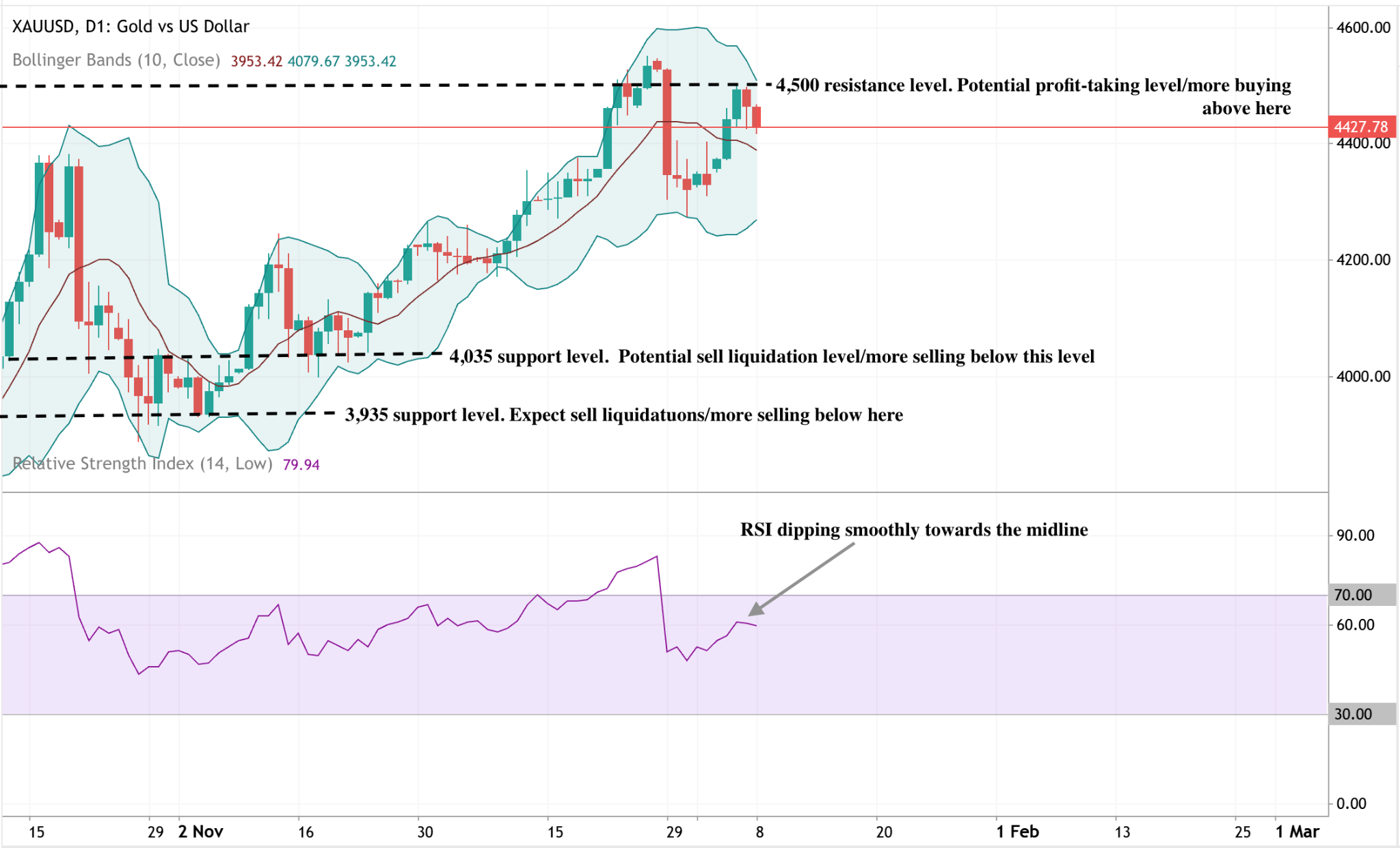
Gold remains in a broader bullish structure but is consolidating after failing to sustain a breakout above the $4,500 resistance zone, an area that has attracted renewed profit-taking. While price has pulled back toward the US$4,430 region, the move appears corrective rather than trend-breaking.
Bollinger Bands remain elevated, reflecting still-high volatility following the rally, but the loss of upside momentum suggests a cooling phase is underway. The RSI is dipping smoothly toward the midline from overbought levels, signalling that bullish pressure is easing without yet flipping bearish.
As long as gold holds above the $4,035 support zone, the underlying uptrend remains intact, with a deeper downside risk only emerging below $3,935. A sustained push back above $4,500 would be needed to reignite upside momentum, while consolidation above support would keep the bullish bias alive.
The performance figures quoted are not a guarantee of future performance.


