Why a Wall Street legend says prices are ‘almost guaranteed’ to drop 50% while Citi targets $150

January 28, 2026
Futuristic curved building overlooking a modern city skyline with elevated roads in the foreground.

Silver hasn’t just rallied, it has erupted, soaring nearly 3x in a year and smashing through $100/oz, even as one of Wall Street’s most famous strategists warns the metal is “almost guaranteed” to drop about 50% from here. Former JPMorgan chief strategist Marko Kolanovic says silver’s parabolic move is a classic speculative blow-off.

How extreme is the silver rally?

Over the past year, silver has rocketed from the low‑30s to record intraday highs around $115–$118 per ounce, delivering roughly a 250–270% gain and outpacing gold and most major equity benchmarks. 

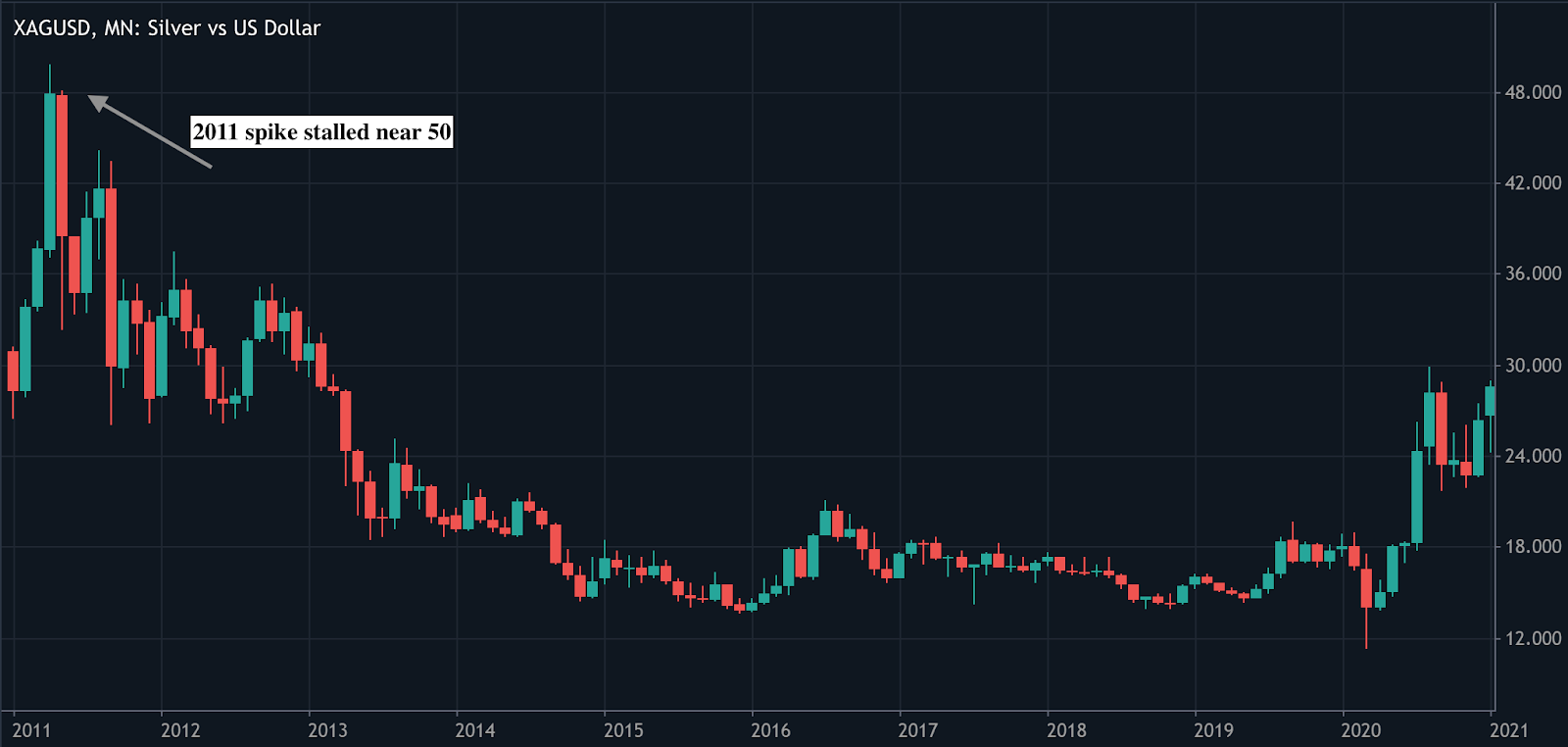
Citi notes that the surge has already pushed silver to an all‑time intraday high near $117.7, compressing the gold‑to‑silver ratio below 50 and underscoring how violently the trade has shifted in silver’s favour. For context, the last major spike in 2011 stalled near $50 before a bruising multi‑year bear market, making today’s price level unprecedented in nominal terms.

Monthly chart of silver prices showing a 2011 peak near $50 followed by a long decline and later recovery.
Source: Deriv MT5

Analysts note that this move has turned silver from a sleepy precious metal into a headline‑grabbing momentum asset, with intraday swings measured in double‑digit percentages. Such volatility is typical of the late stages of commodity booms, where marginal flows and sentiment, not slow‑moving fundamentals, dominate price action.

The bear case: Kolanovic’s “almost guaranteed” 50% crash

Kolanovic’s warning is blunt: he says silver is “almost guaranteed to drop ~50% from these levels within a year or so,” arguing that the current spike bears all the hallmarks of a speculative bubble. 

He points to heavy momentum buying, meme‑style trading behavior, and macro‑fear positioning as key drivers, rather than durable improvements in underlying fundamentals. In his view, silver is trading less like a traditional store of value and more like a leveraged macro instrument that can overshoot violently in both directions.

The logic is grounded in history: commodities that go parabolic rarely plateau smoothly; they tend to mean‑revert hard as positioning unwinds and marginal buyers disappear. The 2011 silver bust and the wild boom‑bust cycles of the 1970s are often cited examples where deep drawdowns followed euphoric peaks without necessarily ending longer‑term secular themes. 

Kolanovic underscores that, unlike purely fictional assets, commodity bubbles eventually collide with physical reality as high prices destroy industrial demand, accelerate recycling, and incentivise new hedged supply.

The bull case: Citi’s $150 target and “gold on steroids”

On the other hand, Citi’s commodities team has become tactically more bullish, raising its 0–3 month silver price target to $150 per ounce, implying another 30–40% upside from recent levels. Citi’s Maximilian Layton writes, “We remain tactically bullish and upgrade our 0–3m point price target to $150/oz,” framing silver’s current behaviour as “gold squared” or “gold on steroids” as capital flows chase macro hedges. 

The bank argues that the rally is being driven primarily by capital flows and speculative demand rather than traditional fundamentals, but believes those flows still have room to run before the market looks expensive relative to gold.

Citi highlights three main supports: heightened geopolitical risks, renewed concerns over Federal Reserve independence, and strong investment and speculative demand led by Chinese and other Asian investors. 

Reporting on the call notes that physical supply outside the United States looks tight, with high premiums in key markets and persistent deficits expected in the coming years. In this framework, silver is expected to overshoot higher before any major normalisation, especially if trend‑following retail flows in China and elsewhere continue to pile into the trade.

Industrial demand, solar, and the substitution risk

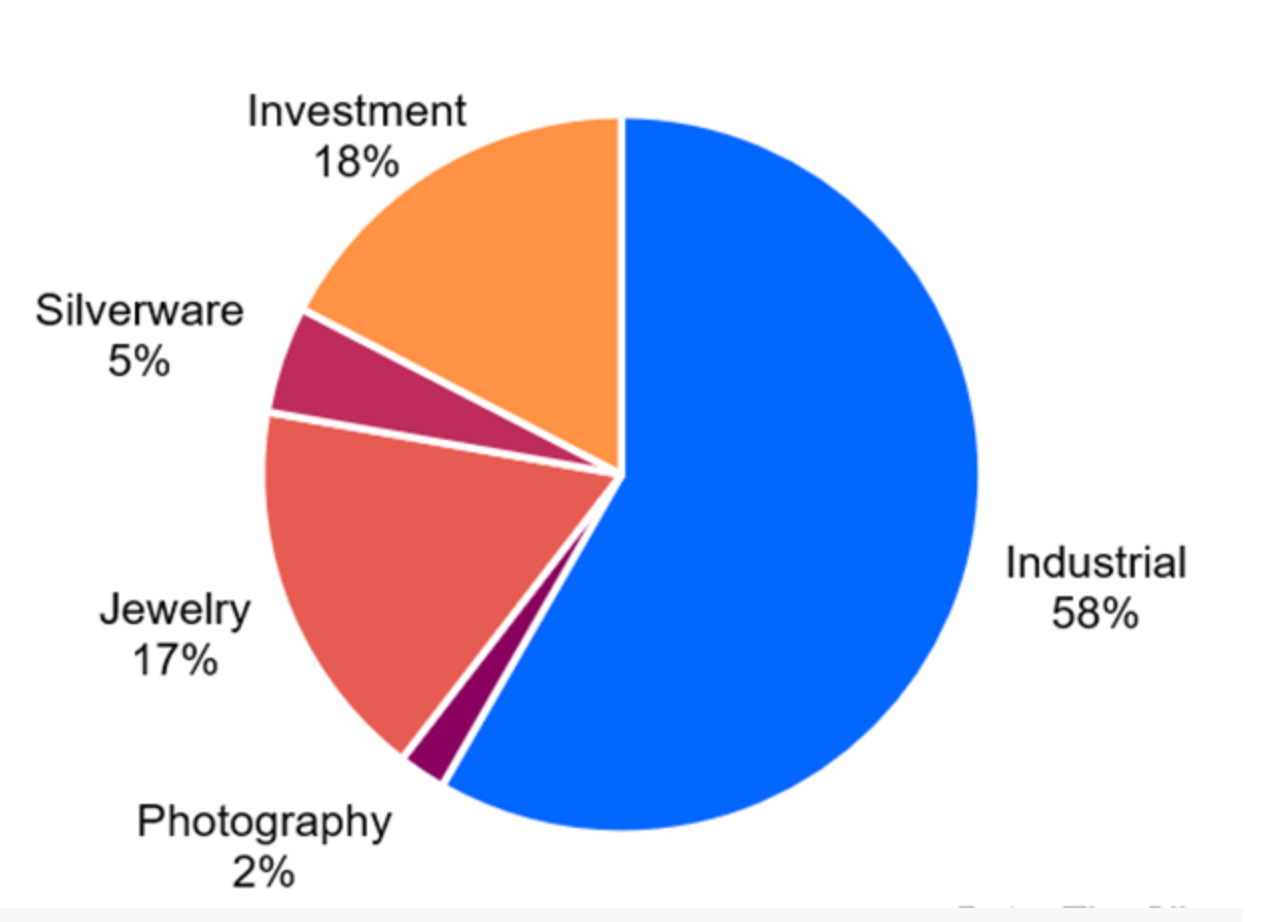
Beneath the speculative froth, silver remains a workhorse industrial metal: industrial applications now account for roughly 58% of global silver demand, with renewable energy, electronics, and automotive uses especially important.

Pie chart showing silver demand by sector, led by industrial use at 58%.
Source: Silver Institute

The Silver Institute and Metals Focus expect industrial demand to reach about 700 million ounces, driven largely by photovoltaics, where silver’s conductivity makes it critical for solar cells. Recent estimates suggest solar alone could represent around 19–20% of total silver demand in 2024, roughly 230 million ounces, and that solar demand has almost doubled versus 2022.

At the same time, high prices are already accelerating “silver thrifting” and substitution by cheaper base metals in some applications. Industry reports describe leading module manufacturers such as LONGi working to cut silver loadings in their solar cells, exploring copper‑based metallisation and other innovations to reduce cost exposure. 

This creates a tension: structurally tight supply and booming green‑economy demand support the bull case, but very high prices also sow the seeds of future demand destruction and substitution - exactly the dynamic Kolanovic warns about.

Positioning, ETFs, China and the new momentum trade

This silver rally looks different from previous cycles because the speculative center of gravity sits elsewhere. Citi observes that several historically bearish signals - such as falling global silver ETF holdings and declining COMEX positioning - have failed to slow prices, indicating that much of the buying is coming from Asian futures and OTC markets rather than Western ETFs. 

Coverage of the move notes that Chinese retail traders have been key players, prompting authorities to tighten conditions, including raising futures margins and limiting new subscriptions to a major domestic silver ETF.

Western vehicles like iShares Silver Trust, Aberdeen Standard Physical Silver, and Sprott Physical Silver Trust remain important gateways for macro and retail investors, but they no longer appear to be the main marginal drivers of this latest leg higher. 

Kolanovic’s warning explicitly frames silver ETFs as crowded macro trades at risk of a sharp positioning unwind, while bearish ETF‑focused products have emerged to let investors position against what some call a “parabolic mania.” Both camps, bull and bear, implicitly agree on one crucial point: positioning is extreme, and any shift in flows could translate into very large moves in either direction over a short period.

What a 50% drawdown or a spike to $150 could mean

Market watchers noted that if Kolanovic is right and silver trades at roughly half its recent price by late 2026, a move from around $110–$115 to the $50–$60 range would inflict heavy losses on late‑cycle buyers, leveraged traders, and higher‑cost miners. Such a drawdown would be painful but not historically unprecedented when measured against prior busts in silver and other commodities. It could also relieve some pressure on industrial users and accelerate a rebalancing where thrifting and substitution slow, demand stabilises and the metal potentially builds a base for the next secular leg higher.

If Citi’s tactical bull case plays out instead, a spike to $150 would further compress the gold–silver ratio and cement silver’s status as the high‑beta expression of macro fear and liquidity. 

However, such levels would likely intensify policy responses in key markets - through tighter margin rules, curbs on speculative access or other measures - and turbo‑charge efforts in solar and electronics to engineer silver out of as many applications as possible. Citi itself cautions that, while the medium‑ to long‑term supply‑demand balance looks tight, short‑term volatility could increase after such a sharp run‑up.

Key takeaway

Silver now sits at an inflection point between momentum and mean reversion. On one side, Citi sees powerful macro flows, tight physical supply, and speculative demand pushing prices as high as $150 in the near term. On the other, Marko Kolanovic warns that history rarely treats parabolic commodity moves kindly, with a 50% drawdown a familiar outcome once positioning unwinds and high prices start to destroy demand.

For traders and investors, the message is clear: silver may still have upside, but it is no longer a quiet inflation hedge - it is a high-volatility, high-conviction macro trade where timing and risk management matter more than ever.

Silver technical outlook

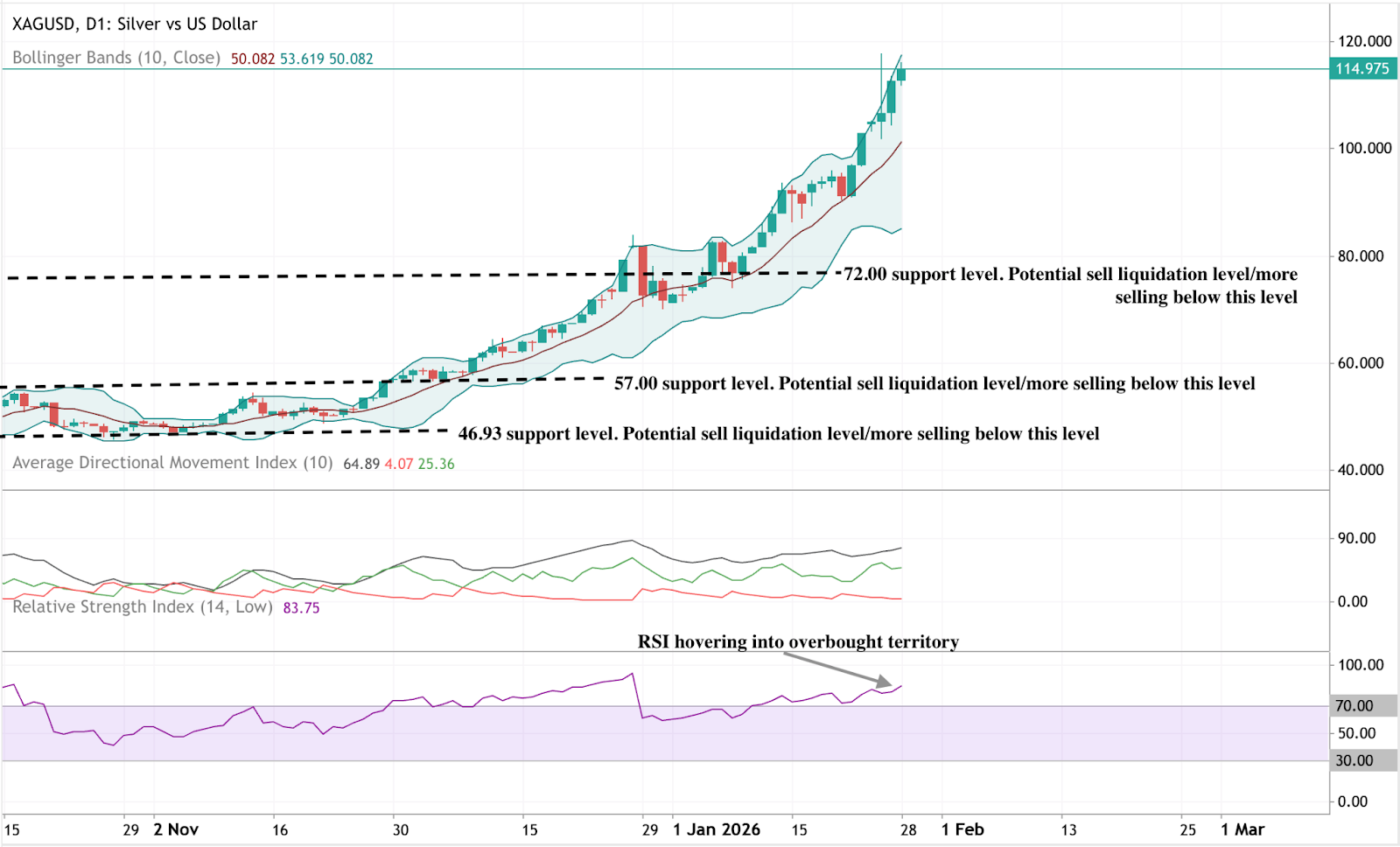
Silver has continued to move higher into new price territory, tracking the upper Bollinger Band as volatility remains elevated. The Bollinger Bands are widely expanded, indicating a sustained high-volatility environment following the recent acceleration. 

Momentum indicators show extreme readings, with the RSI in overbought territory and the ADX at elevated levels, reflecting a strong, mature trend phase. From a structural perspective, current prices sit well above earlier consolidation areas around $72, $57, and $46.93, illustrating the scale of the recent move.

 Daily chart of silver versus the US dollar showing a strong uptrend, with price near 115 and RSI approaching overbought levels.
Source: Deriv MT5

The performance figures quoted are not a guarantee of future performance.

常见问题解答

为什么Marko Kolanovic认为白银价格可能会下跌50%?

Marko Kolanovic认为,白银的快速上涨展现出了典型的投机泡沫迹象。他指出,当前市场存在大量动量买入、模因式交易行为以及宏观恐慌仓位,而不是基本面改善。根据他的观点,呈抛物线式上涨的大宗商品很少会逐步企稳,反而往往会随着仓位解除和边际买家消失而急剧回调,因此在一年左右时间内出现大约50%的下跌“几乎是必然的”。

近期白银的涨势有多极端?

在过去一年里,白银从30美元出头的低位飙升至每盎司约115–118美元的历史盘中高点,涨幅约为250–270%。此次上涨使白银价格达到前所未有的名义高位,远超2011年接近50美元的前高。这一走势还将金银比压缩到50以下,并带来了极端的波动性,盘中价格波动幅度达到两位数百分比。

为什么花旗将白银价格目标定在每盎司150美元?

花旗将其短期(0-3个月)白银价格目标上调至每盎司150美元,因为其认为资本流动和投机性需求仍有上升空间。该行将白银形容为“类黄金的加强版”,其走势受地缘政治风险加剧、美联储独立性担忧以及以中国和其他亚洲投资者为主导的强劲投资需求推动。花旗还指出,美国以外的实物供应紧张,预计未来几年将持续出现供给缺口。

工业和太阳能需求对白银价格有多重要?

工业应用约占全球白银需求的55%,其中可再生能源、电子和汽车行业起着重要作用。仅太阳能一项,预计在2024年将占白银总需求的19-20%左右,约为2.3亿盎司,且太阳能需求相比2022年几乎翻倍。然而,文章指出,高价格正在加速白银节约和替代,尤其是在太阳能制造领域,这最终可能削弱需求。

中国和投资者持仓在白银上涨中扮演了什么角色?

目前的大部分买盘似乎来自亚洲期货和场外市场,而不是西方的白银ETF。中国散户交易者是主要推动力量,这促使监管机构通过提高期货保证金和限制某大型国内白银ETF的新申购来收紧条件。无论是看多还是看空的分析师都认为当前持仓极端,这意味着任何资金流向的变化都可能在短时间内导致价格出现大幅波动。

内容