Why a Wall Street legend says prices are ‘almost guaranteed’ to drop 50% while Citi targets $150

January 28, 2026
Futuristic curved building overlooking a modern city skyline with elevated roads in the foreground.

Silver hasn’t just rallied, it has erupted, soaring nearly 3x in a year and smashing through $100/oz, even as one of Wall Street’s most famous strategists warns the metal is “almost guaranteed” to drop about 50% from here. Former JPMorgan chief strategist Marko Kolanovic says silver’s parabolic move is a classic speculative blow-off.

How extreme is the silver rally?

Over the past year, silver has rocketed from the low‑30s to record intraday highs around $115–$118 per ounce, delivering roughly a 250–270% gain and outpacing gold and most major equity benchmarks. 

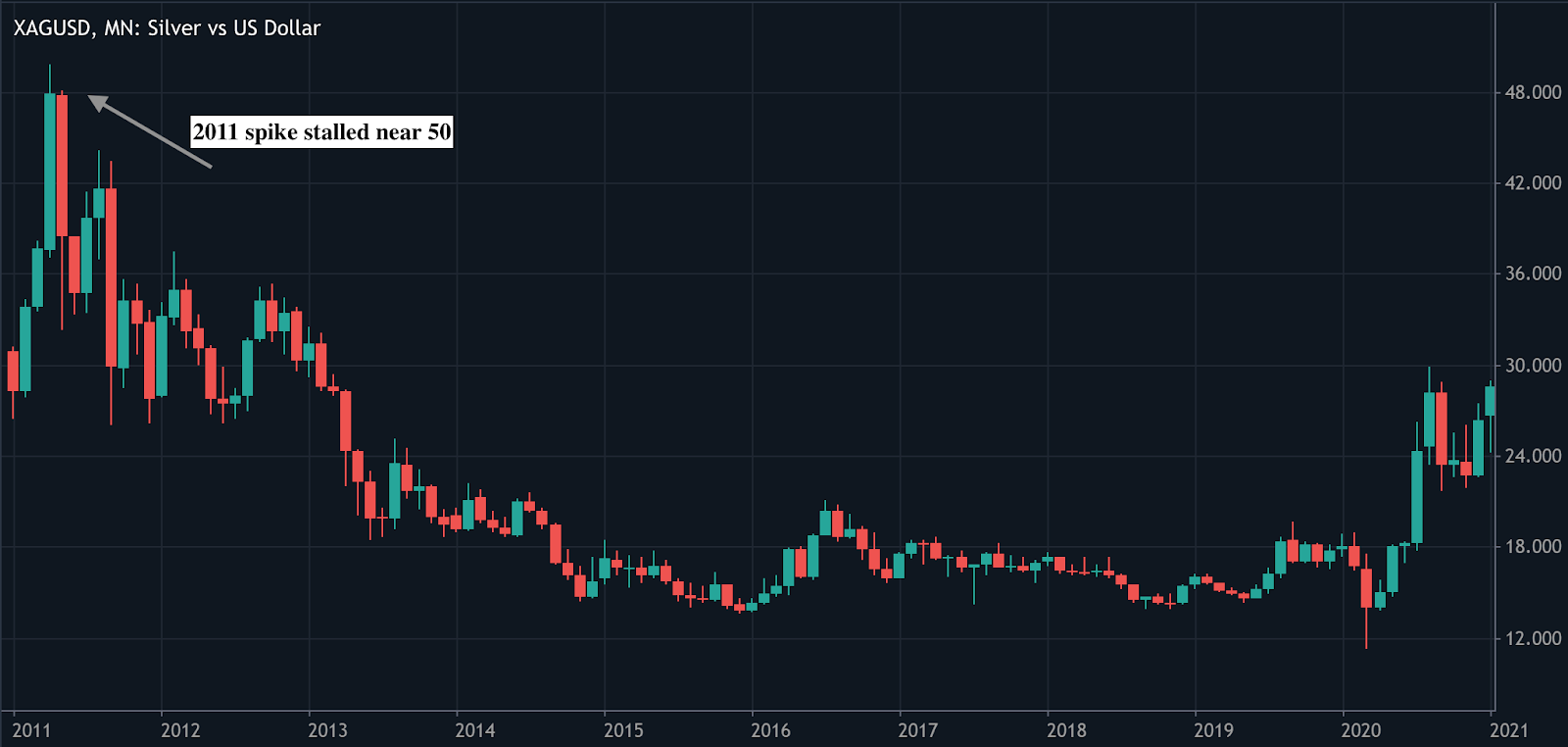
Citi notes that the surge has already pushed silver to an all‑time intraday high near $117.7, compressing the gold‑to‑silver ratio below 50 and underscoring how violently the trade has shifted in silver’s favour. For context, the last major spike in 2011 stalled near $50 before a bruising multi‑year bear market, making today’s price level unprecedented in nominal terms.

Monthly chart of silver prices showing a 2011 peak near $50 followed by a long decline and later recovery.
Source: Deriv MT5

Analysts note that this move has turned silver from a sleepy precious metal into a headline‑grabbing momentum asset, with intraday swings measured in double‑digit percentages. Such volatility is typical of the late stages of commodity booms, where marginal flows and sentiment, not slow‑moving fundamentals, dominate price action.

The bear case: Kolanovic’s “almost guaranteed” 50% crash

Kolanovic’s warning is blunt: he says silver is “almost guaranteed to drop ~50% from these levels within a year or so,” arguing that the current spike bears all the hallmarks of a speculative bubble. 

He points to heavy momentum buying, meme‑style trading behavior, and macro‑fear positioning as key drivers, rather than durable improvements in underlying fundamentals. In his view, silver is trading less like a traditional store of value and more like a leveraged macro instrument that can overshoot violently in both directions.

The logic is grounded in history: commodities that go parabolic rarely plateau smoothly; they tend to mean‑revert hard as positioning unwinds and marginal buyers disappear. The 2011 silver bust and the wild boom‑bust cycles of the 1970s are often cited examples where deep drawdowns followed euphoric peaks without necessarily ending longer‑term secular themes. 

Kolanovic underscores that, unlike purely fictional assets, commodity bubbles eventually collide with physical reality as high prices destroy industrial demand, accelerate recycling, and incentivise new hedged supply.

The bull case: Citi’s $150 target and “gold on steroids”

On the other hand, Citi’s commodities team has become tactically more bullish, raising its 0–3 month silver price target to $150 per ounce, implying another 30–40% upside from recent levels. Citi’s Maximilian Layton writes, “We remain tactically bullish and upgrade our 0–3m point price target to $150/oz,” framing silver’s current behaviour as “gold squared” or “gold on steroids” as capital flows chase macro hedges. 

The bank argues that the rally is being driven primarily by capital flows and speculative demand rather than traditional fundamentals, but believes those flows still have room to run before the market looks expensive relative to gold.

Citi highlights three main supports: heightened geopolitical risks, renewed concerns over Federal Reserve independence, and strong investment and speculative demand led by Chinese and other Asian investors. 

Reporting on the call notes that physical supply outside the United States looks tight, with high premiums in key markets and persistent deficits expected in the coming years. In this framework, silver is expected to overshoot higher before any major normalisation, especially if trend‑following retail flows in China and elsewhere continue to pile into the trade.

Industrial demand, solar, and the substitution risk

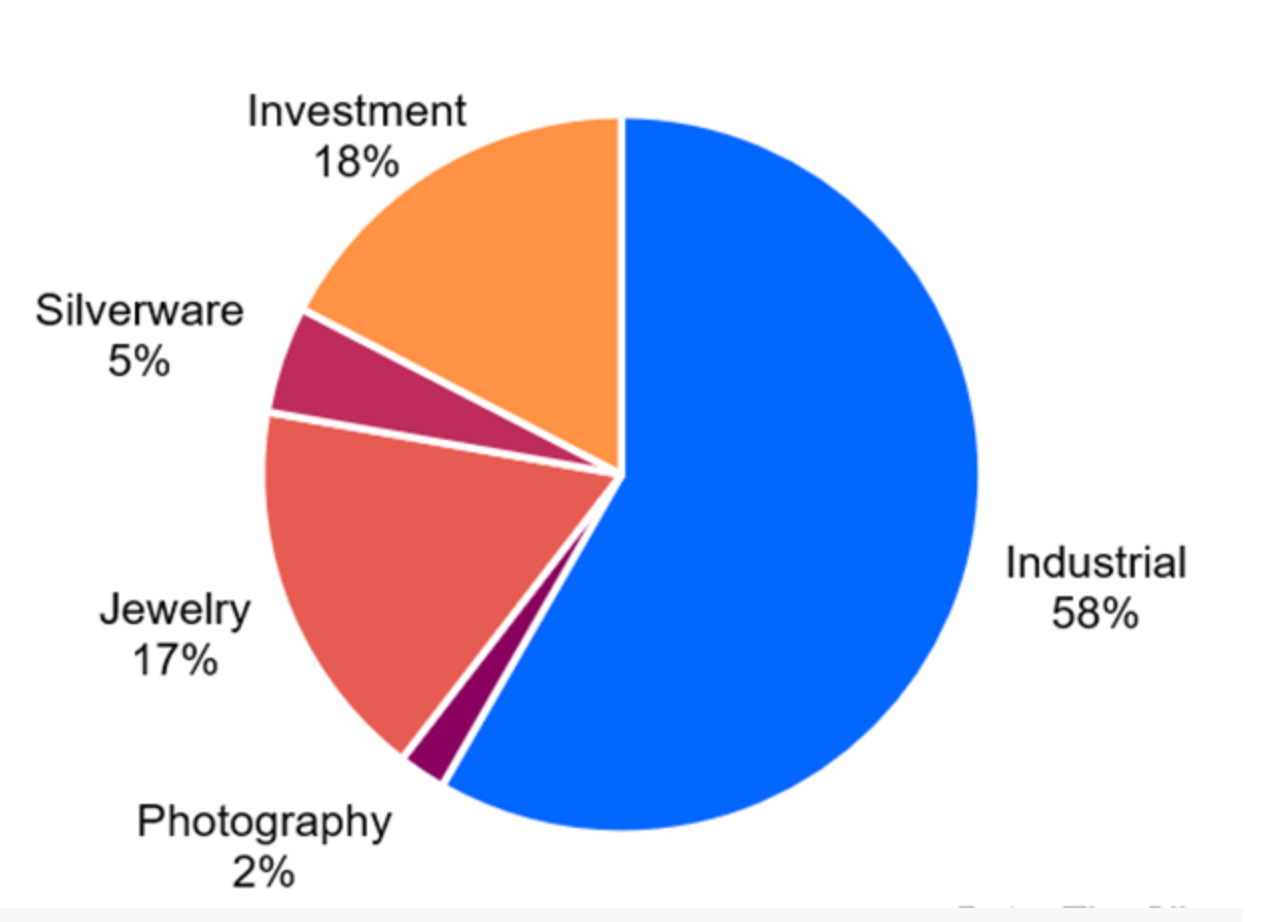
Beneath the speculative froth, silver remains a workhorse industrial metal: industrial applications now account for roughly 58% of global silver demand, with renewable energy, electronics, and automotive uses especially important.

Pie chart showing silver demand by sector, led by industrial use at 58%.
Source: Silver Institute

The Silver Institute and Metals Focus expect industrial demand to reach about 700 million ounces, driven largely by photovoltaics, where silver’s conductivity makes it critical for solar cells. Recent estimates suggest solar alone could represent around 19–20% of total silver demand in 2024, roughly 230 million ounces, and that solar demand has almost doubled versus 2022.

At the same time, high prices are already accelerating “silver thrifting” and substitution by cheaper base metals in some applications. Industry reports describe leading module manufacturers such as LONGi working to cut silver loadings in their solar cells, exploring copper‑based metallisation and other innovations to reduce cost exposure. 

This creates a tension: structurally tight supply and booming green‑economy demand support the bull case, but very high prices also sow the seeds of future demand destruction and substitution - exactly the dynamic Kolanovic warns about.

Positioning, ETFs, China and the new momentum trade

This silver rally looks different from previous cycles because the speculative center of gravity sits elsewhere. Citi observes that several historically bearish signals - such as falling global silver ETF holdings and declining COMEX positioning - have failed to slow prices, indicating that much of the buying is coming from Asian futures and OTC markets rather than Western ETFs. 

Coverage of the move notes that Chinese retail traders have been key players, prompting authorities to tighten conditions, including raising futures margins and limiting new subscriptions to a major domestic silver ETF.

Western vehicles like iShares Silver Trust, Aberdeen Standard Physical Silver, and Sprott Physical Silver Trust remain important gateways for macro and retail investors, but they no longer appear to be the main marginal drivers of this latest leg higher. 

Kolanovic’s warning explicitly frames silver ETFs as crowded macro trades at risk of a sharp positioning unwind, while bearish ETF‑focused products have emerged to let investors position against what some call a “parabolic mania.” Both camps, bull and bear, implicitly agree on one crucial point: positioning is extreme, and any shift in flows could translate into very large moves in either direction over a short period.

What a 50% drawdown or a spike to $150 could mean

Market watchers noted that if Kolanovic is right and silver trades at roughly half its recent price by late 2026, a move from around $110–$115 to the $50–$60 range would inflict heavy losses on late‑cycle buyers, leveraged traders, and higher‑cost miners. Such a drawdown would be painful but not historically unprecedented when measured against prior busts in silver and other commodities. It could also relieve some pressure on industrial users and accelerate a rebalancing where thrifting and substitution slow, demand stabilises and the metal potentially builds a base for the next secular leg higher.

If Citi’s tactical bull case plays out instead, a spike to $150 would further compress the gold–silver ratio and cement silver’s status as the high‑beta expression of macro fear and liquidity. 

However, such levels would likely intensify policy responses in key markets - through tighter margin rules, curbs on speculative access or other measures - and turbo‑charge efforts in solar and electronics to engineer silver out of as many applications as possible. Citi itself cautions that, while the medium‑ to long‑term supply‑demand balance looks tight, short‑term volatility could increase after such a sharp run‑up.

Key takeaway

Silver now sits at an inflection point between momentum and mean reversion. On one side, Citi sees powerful macro flows, tight physical supply, and speculative demand pushing prices as high as $150 in the near term. On the other, Marko Kolanovic warns that history rarely treats parabolic commodity moves kindly, with a 50% drawdown a familiar outcome once positioning unwinds and high prices start to destroy demand.

For traders and investors, the message is clear: silver may still have upside, but it is no longer a quiet inflation hedge - it is a high-volatility, high-conviction macro trade where timing and risk management matter more than ever.

Silver technical outlook

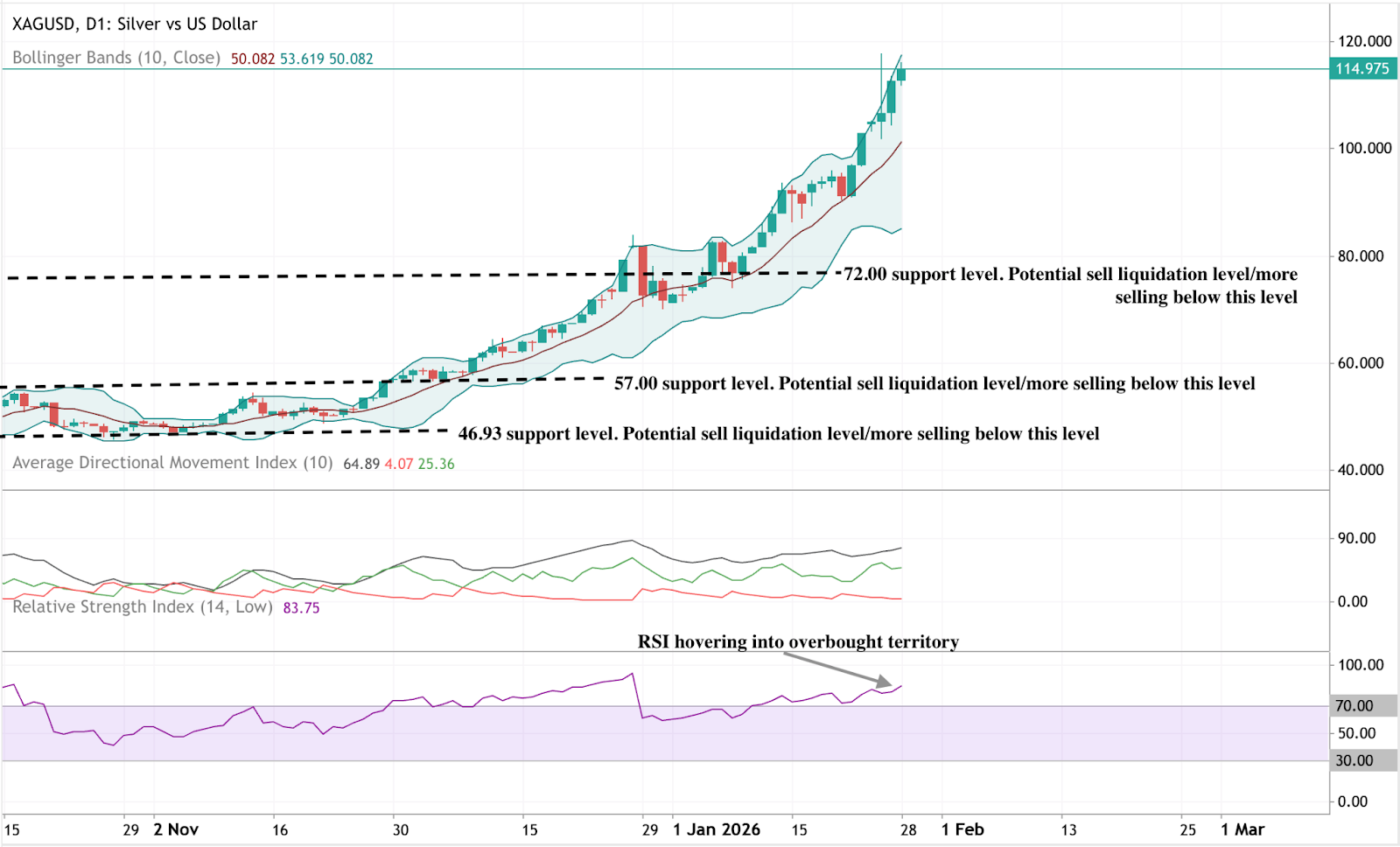
Silver has continued to move higher into new price territory, tracking the upper Bollinger Band as volatility remains elevated. The Bollinger Bands are widely expanded, indicating a sustained high-volatility environment following the recent acceleration. 

Momentum indicators show extreme readings, with the RSI in overbought territory and the ADX at elevated levels, reflecting a strong, mature trend phase. From a structural perspective, current prices sit well above earlier consolidation areas around $72, $57, and $46.93, illustrating the scale of the recent move.

 Daily chart of silver versus the US dollar showing a strong uptrend, with price near 115 and RSI approaching overbought levels.
Source: Deriv MT5

The performance figures quoted are not a guarantee of future performance.

자주 묻는 질문

마르코 콜라노비치가 은 가격이 50% 하락할 수 있다고 믿는 이유는?

마르코 콜라노비치는 은의 급격한 상승이 전형적인 투기적 거품의 징후를 보인다고 주장합니다. 그는 근본적인 펀더멘털의 개선보다는 강한 모멘텀 매수, 밈 스타일의 거래 행태, 거시적 공포에 따른 포지셔닝을 지적합니다. 그의 말에 따르면, 포물선형으로 상승한 원자재는 점진적으로 안정되는 경우가 드물고, 포지션이 청산되고 한계 매수자가 사라지면서 급격하게 평균으로 회귀하는 경향이 있어, 약 1년 내에 50% 하락이 “거의 확실하다”고 합니다.

최근 실버 랠리는 얼마나 극단적이었나?

지난 1년 동안 실버는 30달러대 초반에서 온스당 약 115~118달러의 사상 최고치까지 급등하며 약 250~270%의 수익률을 기록했습니다. 이번 랠리로 인해 실버는 2011년의 약 50달러였던 이전 고점을 훨씬 웃도는 사상 유례없는 명목 가격 수준에 도달했습니다. 이 움직임은 금-은 비율을 50 이하로 압축시켰고, 일중 가격 변동폭이 두 자릿수 퍼센트에 달하는 극심한 변동성도 동반했습니다.

왜 Citi는 온스당 은 가격 목표를 150달러로 설정했을까?

Citi는 자본 유입과 투기적 수요가 아직 더 이어질 여지가 있다고 판단하여 단기(0~3개월) 은 가격 목표를 온스당 150달러로 상향 조정했습니다. 은은 “스테로이드를 맞은 금”처럼 움직인다고 은행은 설명하며, 이는 고조된 지정학적 위험, Federal Reserve의 독립성에 대한 우려, 그리고 중국 및 기타 아시아 투자자들이 주도하는 강한 투자 수요에 의해 촉진되고 있습니다. Citi는 또한 미국 외 지역에서 실물 공급이 부족하고, 앞으로도 지속적인 공급 부족이 예상된다고 언급합니다.

산업 및 태양광 수요가 은 가격에 얼마나 중요한가요?

산업용 응용 분야는 전 세계 은 수요의 약 55%를 차지하며, 재생 에너지, 전자제품, 자동차 분야가 주요 역할을 합니다. 태양광 발전만 해도 2024년 전체 은 수요의 약 19~20%, 즉 약 2억 3천만 온스를 차지할 것으로 추정되며, 태양광 수요는 2022년과 비교해 거의 두 배로 증가했습니다. 그러나 기사에서는 높은 가격으로 인해 특히 태양광 제조 분야에서 은의 절약 및 대체가 가속화되고 있어, 결국 수요가 약화될 수 있다고 언급하고 있습니다.

중국과 투자자 포지셔닝은 은 랠리에서 어떤 역할을 하고 있나요?

현재 매수세의 상당 부분은 서구의 은 ETF보다는 아시아 선물 및 장외 시장에서 유입되고 있는 것으로 보입니다. 중국의 개인 투자자들이 주요 동인으로 작용하면서, 당국은 선물 증거금 인상과 주요 국내 은 ETF에 대한 신규 가입 제한 등 조건을 강화했습니다. 강세와 약세를 주장하는 애널리스트 모두 포지셔닝이 극단적이라는 데 동의하고 있으며, 자금 흐름에 변화가 생길 경우 단기간에 가격이 어느 방향으로든 매우 크게 움직일 수 있습니다.

콘텐츠