
Will USD/JPY breach 157 after Japan’s quake?

USD/JPY is trading firmly above 156 after Japan’s powerful 7.6-magnitude earthquake weakened the Yen and intensified speculation about the Bank of Japan’s next move. The disaster hit an economy already contracting at a 2.3% annual rate, while wage growth of 2.6% in October had previously strengthened expectations of a December rate hike. Markets now face a more uncertain policy landscape as Japan assesses the damage.
The key question is whether this combination of Yen softness and a potentially hawkish 25-basis-point rate cut from the Federal Reserve will propel the pair through the 157 threshold. With the Fed preparing its final decision of the year and Japan contending with an unexpected economic shock, traders are positioning for what could be the next decisive leg in the USD/JPY trend.
What’s driving USD/JPY higher?
The Yen’s decline reflects structural fragility colliding with a sudden natural disaster. Monday’s quake triggered widespread tsunami warnings from Hokkaido to Chiba and forced about 90,000 residents to evacuate.
Investors immediately reduced Yen exposure, anticipating economic strain and disrupted activity at a time when Japan’s GDP has already been revised to a sharp 2.3% annualised contraction. Although rising wages had supported hopes for a December BoJ hike, the quake has forced traders to recalculate the likelihood of near-term tightening.
The US dollar, meanwhile, benefits from expectations of a “hawkish cut” from the Federal Reserve. Analysts assign a 89.6% probability of a 25-bp reduction this week, yet inflation remains around 3% year-on-year above target.
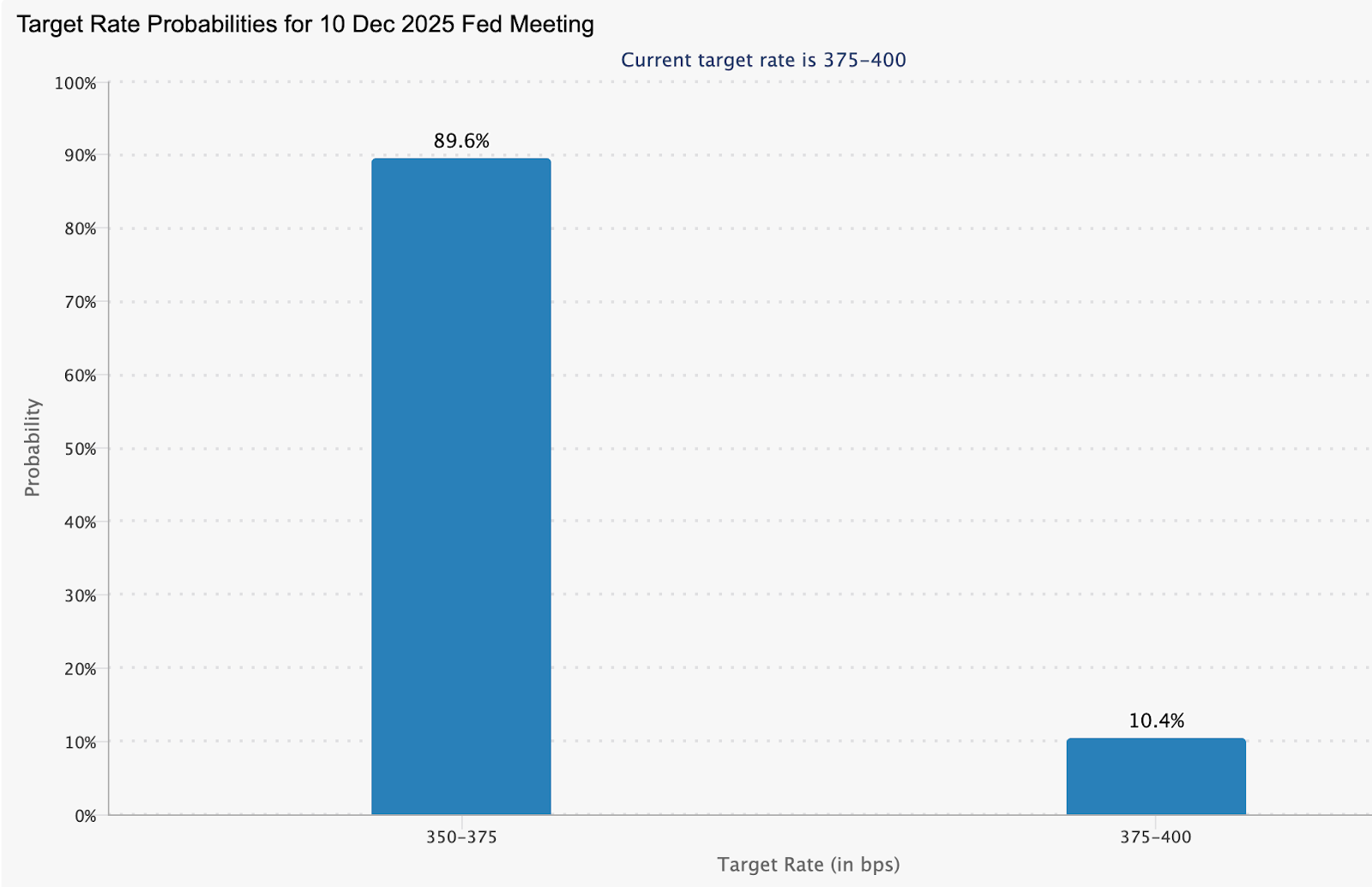
This sets the stage for a rate cut accompanied by firmer language. The widening yield differential has strengthened the dollar’s appeal, helping lift USD/JPY convincingly through 156 and leaving 157 as the next technical barrier.
Why it matters
FX markets often treat USD/JPY as a stress gauge, and its latest move reflects a convergence of economic uncertainty and shifting rate expectations. The quake complicates Japan’s policy path, raising doubts about whether the BoJ can proceed with tightening just as reconstruction efforts and economic stabilisation become priorities. This tension sits uncomfortably against the backdrop of still-elevated JGB yields, which had previously signalled confidence in a December hike.
According to a Tokyo-based strategist, “the BoJ’s room for manoeuvre has narrowed at the worst possible moment,” capturing a sentiment that now shapes market pricing. Investors must weigh the risk of a delayed hike against the possibility that the BoJ presses ahead to preserve credibility. Either outcome carries consequences for carry trades, hedging decisions and broader market sentiment, which is why USD/JPY’s move has drawn global attention.
Impact on markets and investors
With the pair now above 156, some traders have renewed long positioning in anticipation of further gains, according to analysts. Rising US yields and uncertainty around the BoJ’s next step have reinforced the dollar’s advantage.
Historical comparisons to the 1995 Hanshin earthquake, when policymakers maintained accommodative conditions for months, have resurfaced, fueling expectations that the central bank may avoid tightening during a period of recovery.
Derivatives markets reflect a similar outlook. Demand has increased for USD/JPY call options with strikes at 156.50, 157.00 and above, as traders seek exposure to the next potential breakout. Volatility is rising ahead of the Fed decision, prompting more participants to adopt long straddles that profit from large directional moves. Defined-risk structures such as bull call spreads remain attractive for investors seeking controlled leverage in an environment where policy signals can shift quickly.
Expert outlook
Whether USD/JPY can breach 157 depends on how the two central banks interpret risk in the days ahead. A cautious BoJ that delays its planned hike could send the pair higher, especially if the Fed confirms that rate cuts next year will be gradual. But a decisive inflation-fighting message from the BoJ or a surprisingly dovish tone from the Fed could pause the rally.
The next catalysts arrive imminently. US ADP and JOLTS readings will help clarify the labour-market slowdown, while Japan’s evolving post-quake assessments may alter expectations for monetary normalisation. With both economies nearing pivotal announcements, the backdrop is set for volatility. Markets now watch not only whether USD/JPY can reach 157, but whether a sustained breakout is justified by policy and economic reality.
Key takeaway
USD/JPY has pushed above 156 and now approaches a critical test at 157 as traders weigh Japan’s post-quake uncertainty against a cautious Federal Reserve. The yield differential continues to favour the dollar, but the BoJ’s response to the crisis remains the biggest wildcard. Volatility is expected to rise as crucial US data and central-bank decisions converge, making the next movements in the pair highly event-driven.
USD/JPY technical insights
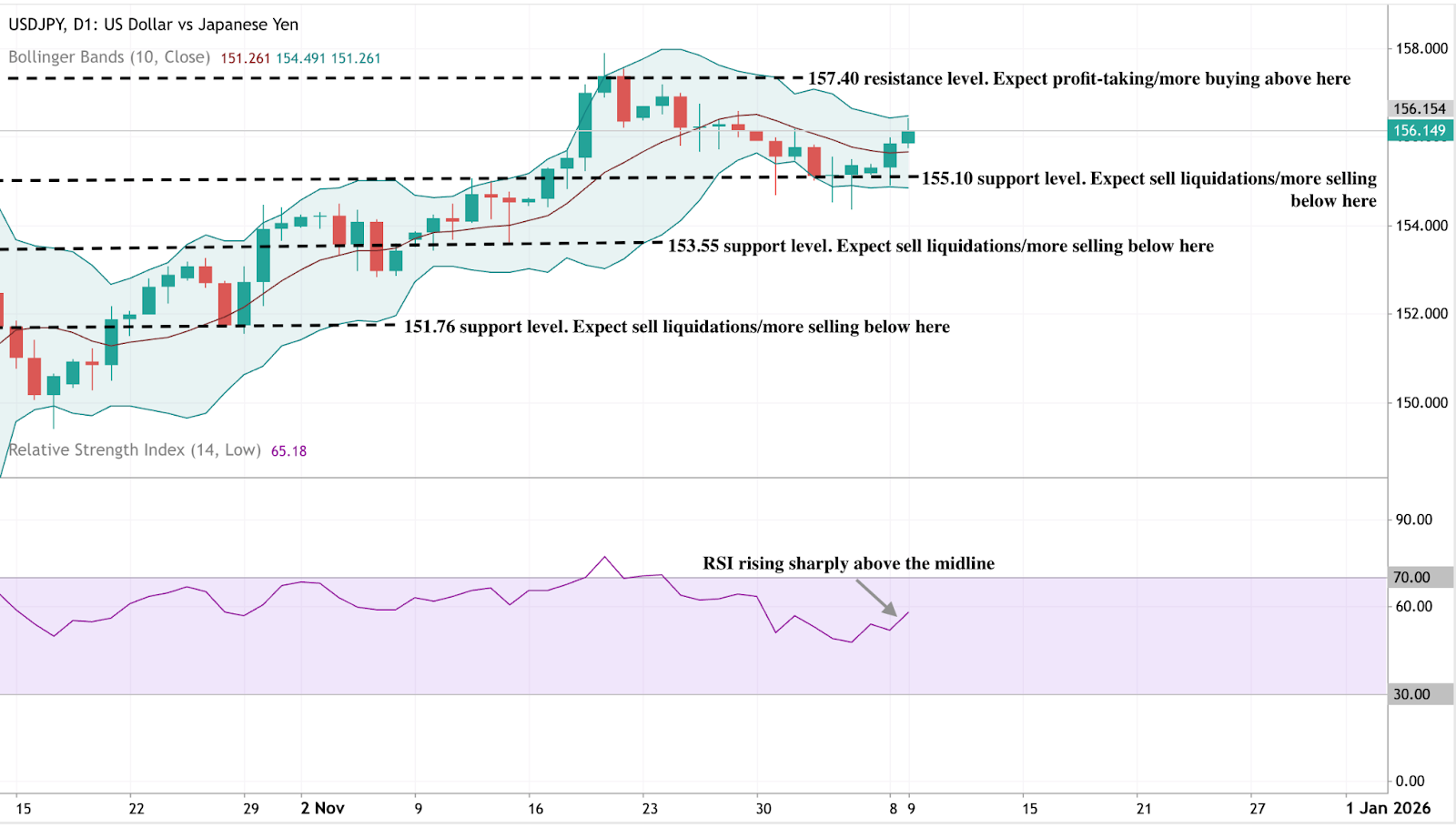
At the start of writing, USD/JPY is trading near 156.15, attempting to build momentum after bouncing from recent lows. The pair is now edging toward the 157.40 resistance level, where traders often expect profit-taking or fresh bullish interest if price breaks higher. On the downside, the nearest supports sit at 155.10, 153.55, and 151.76 - with a break below any of these levels likely to trigger sell liquidations and deepen the pullback.
Price action is improving, with USD/JPY moving back toward the upper Bollinger Band after a short consolidation period. This suggests buyers are regaining control, although the pair still needs a clean break above resistance to confirm a continuation of the broader uptrend.
The RSI, now rising sharply above 65, highlights strengthening bullish momentum. While not yet overbought, the indicator signals increasing buying pressure - a favourable setup for further upside if the pair can overcome the 157.40 barrier.
The performance figures quoted are not a guarantee of future performance.


