
Meta stock slips despite strong rally as AI spending fears resurface
%20(1)%20(1)%20(1)%20(1)%20(1).png)
Meta Platforms entered the final trading days of the year on a softer footing, despite a standout rally that has lifted the stock by more than 75% year to date. Data showed shares slipped modestly on Monday, closing near $660, as thin holiday volumes amplified routine year-end profit-taking and insider sales, which briefly unsettled sentiment.
The pullback may look minor on the surface, but it highlights a deeper tension facing Big Tech. Investors are weighing Meta’s expanding artificial intelligence ambitions against memories of past capital-spending missteps. With only a handful of sessions left before 2026, that debate is beginning to shape near-term price action.
What’s driving Meta’s latest pullback?
The immediate pressure on Meta shares reportedly came from seasonal dynamics rather than any shift in fundamentals. After rallying sharply through most of 2025, the stock entered the final week of the year near levels that naturally invite profit-taking. According to analysts, light holiday trading tends to exaggerate these moves, particularly in mega-cap stocks that dominate index weightings.
That backdrop coincided with Meta’s December dividend cycle and a pair of small insider sales. Two executives sold a combined total of just over 1,000 shares on 15 December at roughly $646 per share, transactions worth less than $1 million and pre-scheduled under Rule 10b5-1 trading plans. While immaterial in size, the timing fed a short-term narrative of position trimming that traders were quick to price in during a quiet session.
Why it matters
Short-term selling alone would not normally merit attention. According to reports, what makes this move more meaningful is the sensitivity investors still show toward Meta’s spending discipline. In October, the company warned that expenses in 2026 would grow “significantly faster” than in 2025, driven by AI infrastructure and cloud investment expected to exceed $40 billion.
That language revived uncomfortable comparisons to 2021 and 2022, when heavy metaverse spending erased more than $300 billion in market value as investors lost patience. Jason Helfstein, an analyst at Oppenheimer, has cautioned that markets remain “quick to punish” Meta if capital intensity starts to outpace visible returns. Even modest pullbacks now reflect that lingering scepticism.
Impact on the tech market
Meta’s dip did not occur in isolation. The broader technology complex also cooled as the Nasdaq and S&P 500 retreated from record highs, with investors locking in gains across heavyweight growth stocks. Nvidia and Tesla, fellow members of the so-called “Magnificent Seven,” also finished lower, reinforcing the sense of coordinated year-end de-risking.
Market experts noted that because Meta carries substantial index weight, its movements increasingly act as a barometer for risk appetite in mega-cap tech. When the stock softens without company-specific news, it often signals broader concerns about valuations, rates, or the sustainability of AI-driven earnings expectations. In that context, Monday’s decline looked less like a verdict on Meta and more like a pause across the sector.
Meta’s AI ambitions add a new layer of scrutiny
Investor caution has been sharpened by Meta’s accelerating push into advanced AI. The company recently confirmed its acquisition of Manus, a Singapore-based autonomous AI agent startup that reportedly reached $100 million in annual recurring revenue within eight months of launch. Manus’s technology will be integrated across Meta’s consumer and business products, including Meta AI.
Strategically, the deal strengthens Meta’s position in general-purpose AI agents, an area seen as the next phase of monetisation beyond chat interfaces. Financially, however, it reinforces the perception that Meta is entering another heavy-investment cycle. Combined with the launch of Meta Superintelligence Labs and aggressive infrastructure build-outs, investors are watching closely to see whether returns materialise faster than they did during the metaverse era.
Expert outlook
In the near term, traders are focused less on headlines and more on technical levels. A sustained move below the mid-$650 range could test late-December support, while a recovery above $660 would suggest the selling pressure was largely seasonal. Volume remains the key signal, as thin liquidity can distort price discovery.
Looking ahead to early February, when Meta is expected to report earnings based on historical patterns, attention will likely shift back to guidance rather than revenue alone. Investors want clarity on how quickly AI investment can translate into advertising growth and margin stability. Until then, Meta shares are likely to trade as a proxy for confidence in Big Tech’s AI spending cycle.
Key takeaway
Meta’s late-year dip says more about investor positioning than company performance. Following a powerful rally, traders are cautious as AI spending intensifies and liquidity thins. The stock remains caught between confidence in long-term AI monetisation and sensitivity to capital-intensity risks. The next earnings update will be the decisive moment to see which narrative prevails.
Meta technical insights
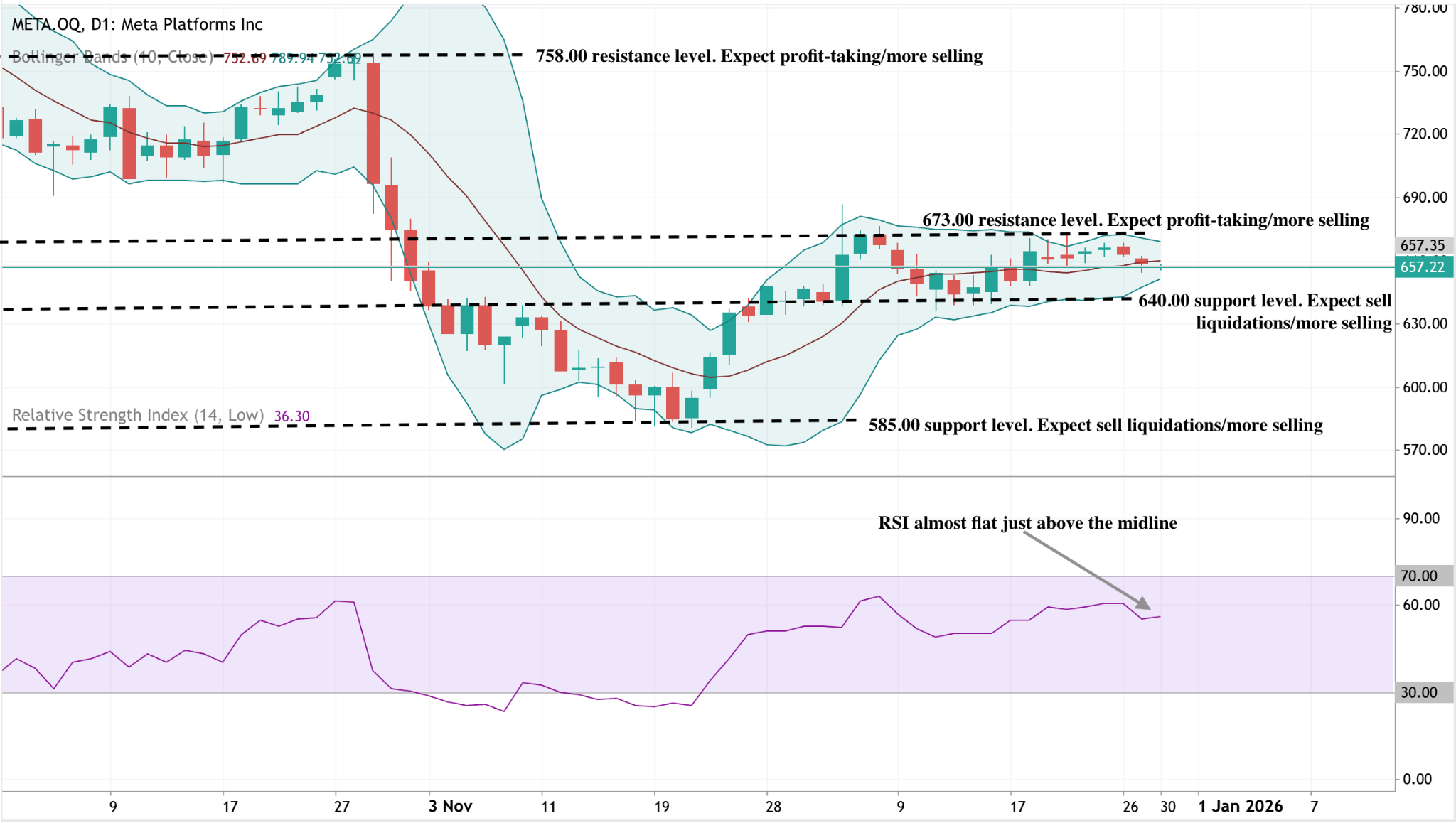
Meta is consolidating after a sharp pullback, with price trading around the Bollinger mid-band, signalling a pause in momentum rather than a renewed trend. The upside remains capped below the $673 resistance level, where rallies have repeatedly drawn profit-taking.
On the downside, $640 is the first key support, followed by $585 if selling pressure resumes. A sustained move back below the mid-band would tilt the bias lower. Momentum remains neutral, with the RSI almost flat just above the midline, highlighting a lack of strong conviction from either buyers or sellers.
The performance figures quoted are not a guarantee of future performance.


