
Microsoft Copilot ARPU vs Nvidia GPU economics: Who wins the AI upside in 2025?
The battle for AI profitability in 2025 is unfolding along two very different economic frontiers. Microsoft is increasing average revenue per user by embedding Copilot deeply into its subscription stack, while Nvidia is capturing extraordinary margins from the hardware required to support the AI boom.
Both companies are riding the same wave, yet each extracts value from a different layer of the ecosystem. The question now is whether software monetisation or compute dominance ultimately delivers the stronger upside as enterprise AI spending matures.
Early signals show both models accelerating. Microsoft reported 18% year-on-year revenue growth in its latest quarter, driven partly by Copilot’s integration into Microsoft 365. Nvidia’s reported three-year, 960% share price surge reflects insatiable demand for its Blackwell GPUs and CUDA stack. The next phase of AI adoption will show whether recurring subscription revenue or high-margin infrastructure economics holds the edge, according to market watchers.
ARPU vs GPU economics - The simple breakdown
Understanding the divide between Microsoft and Nvidia starts with a straightforward analogy, many analysts noted: who makes more money during a gold rush-the miners selling shiny nuggets, or the merchants selling the picks and shovels?
Microsoft is effectively selling the “finished” AI experience through Copilot: the productivity boost, the task automation, the chat interfaces that workers interact with every day. Each subscriber adds to Microsoft’s average revenue per user (ARPU), so the economic engine depends on millions of customers paying a bit more each month.
Nvidia is the pick-and-shovel merchant, according to analysts. Every AI model-from chatbots to Copilot itself, runs on GPUs that train, infer and serve billions of queries. The economics are completely different: instead of collecting small monthly fees from users, Nvidia earns large, upfront, high-margin revenue from hyperscalers buying hardware in vast quantities.
When AI adoption accelerates, GPU demand explodes; when budgets tighten, orders pause just as dramatically. Both companies profit from the same AI trend, but one generates revenue each month through subscriptions, while the other earns money when the world needs more computational horsepower.
What’s driving Microsoft Copilot ARPU vs Nvidia GPU economics
Microsoft has repositioned AI as a default layer of productivity, not an optional add-on. Reports showed the company’s decision to fold the £20 Copilot Pro subscription into a £19.99 Microsoft 365 Premium plan drives uptake, reduces churn, and materially increases ARPU. This shift occurs in a market already primed for higher SaaS prices, as sector-wide subscriptions rose 11.4% in 2025, surpassing G7 inflation several times over.
Copilot is becoming the centrepiece of Microsoft’s long-term revenue story, tightly binding AI utility to the daily workflows of its global base. Nvidia’s economics are powered by scarcity and scale. Generative AI has pushed demand for compute to historic highs, and Nvidia sits at the centre with its Blackwell GPU architecture and CUDA ecosystem. Hyperscalers rely on Nvidia for model training and inference, while a new partnership with Palantir pulls the company deeper into enterprise operational workflows.
Experts expressed this marks a shift from being the engine behind AI model development to a full-stack infrastructure provider supporting defence, healthcare, logistics and advanced analytics. Such breadth is expanding Nvidia’s total addressable market well beyond conventional silicon cycles.
Why it matters
Copilot’s monetisation model introduces both growth and fragility, according to analysts. Subscription inflation within the SaaS sector is drawing scrutiny as consumers question whether bundled AI tools consistently deliver meaningful value. Adobe and Google have faced similar scepticism after 16%–33% price adjustments tied to generative features.
One strategist put it bluntly this week: “the market is no longer willing to pay AI premiums without immediate productivity returns”. Microsoft must prove Copilot enhances real-world output at a pace that justifies higher prices.
Reports also revealed that Nvidia operates at a different pressure point. Its revenues are now a barometer for global AI investment, making the stock highly sensitive to any hint of slowing hyperscale demand. That dynamic was evident when rumours surfaced that Microsoft had cut targets for its AI agent products; AI shares from Nvidia to Micron fell sharply before Microsoft clarified the situation. Investors increasingly treat Nvidia as the pulse of enterprise AI budgets, meaning sentiment swings can be swift.
Impact on the industry, markets and consumers
Across the software industry, AI-powered pricing is reshaping economic expectations. By locking Copilot inside core Microsoft 365 bundles, Microsoft has effectively legitimised double-digit subscription increases.
Reported movements of competitors, including Slack, Salesforce, and Adobe showed they are following this path, swapping optional AI upgrades for compulsory rebrands with higher monthly fees. Consumers - especially creatives and SMEs - are pushing back, questioning whether tools like Firefly or Acrobat AI Assistant warrant the rising costs.
Market behaviour has begun reflecting this divide. Value stocks gained momentum when Microsoft’s AI quota scare briefly knocked confidence in high-multiple tech names. Meanwhile, Nvidia’s deepening integration with Palantir signals a strategic widening of compute-driven AI applications, from supply-chain modelling to advanced defence systems. This diversification not only supports GPU demand but bolsters Nvidia’s positioning as the backbone of agentic, real-time AI decision-making.
For consumers, pricing models remain the flashpoint. Subscription fatigue is spreading as AI features, once marketed as optional, become unavoidable. Hybrid structures that mix subscriptions with AI credits offer some relief, yet introduce new complexity and potential unpredictability. The perceived mismatch between cost and practical value is the core risk facing the SaaS sector.
Expert outlook
According to analystrs, two scenarios define the AI profit landscape in 2025. If enterprises adopt AI agents at scale, Microsoft’s ARPU expansion could continue to be a reliable growth engine. With 66% of CEOs reporting operational benefits from Copilot deployments, early productivity returns appear genuine. Yet the backlash against forced bundling means Microsoft must demonstrate sustained value rather than rely on pricing power alone.
Nvidia’s trajectory hinges on hyperscaler spending and competitive pressure. While demand for GPUs remains fierce, rivals such as Google and Amazon are increasing investment in custom AI chips.
Google’s £10 billion TPU partnership with Anthropic signals a meaningful shift toward in-house compute strategies. Even so, Nvidia’s expansion into operational AI through Palantir may insulate the company by embedding its hardware into mission-critical enterprise systems with long replacement cycles.
Investors will track enterprise AI budgets, regulatory commentary on compute intensity and the Federal Reserve’s next steps. These factors will determine whether software ARPU or hardware economics proves more resilient.
Key takeaway
Microsoft and Nvidia represent two dominant pathways to AI profitability: recurring software monetisation and capital-intensive compute economics. Copilot’s ARPU uplift demonstrates how software firms are extracting value through bundling, while Nvidia’s GPU dominance reveals the physical backbone that enables the AI boom. Both face pressure - Microsoft from consumer fatigue, Nvidia from escalating competition and hyperscaler caution. The deciding factor in 2025 will be how quickly enterprises scale AI beyond experimentation and into daily operations.
Microsoft vs Nvidia technical insights
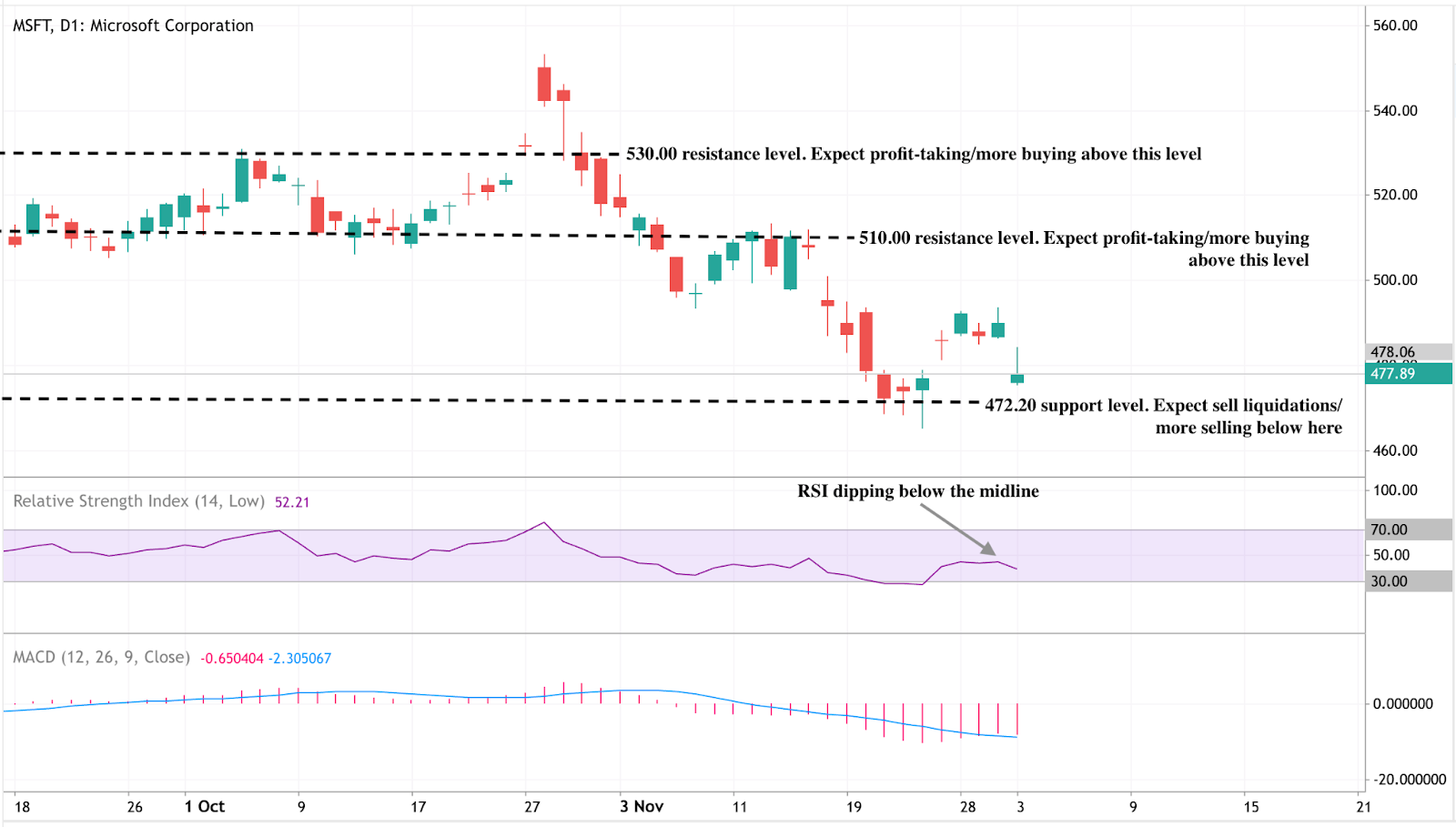
At the start of writing, Microsoft (MSFT) is trading around $478, attempting to stabilise after its recent decline. The nearest support level sits at $472.20, and a break below this level could trigger sell liquidations and open the door to deeper downside movement. On the upside, the stock faces two notable resistance zones at $510.00 and $530.00, where traders may look for profit-taking; however, a strong breakout above these levels would hint at a return of bullish momentum.
Recent price action indicates a market in consolidation, with MSFT struggling to regain altitude after the sharp decline from its early November highs. Candles remain mixed, showing hesitation as buyers and sellers vie for control.
The RSI has dipped slightly below the midline to around 52, signalling weakening momentum and a cautious tone among traders. Meanwhile, the MACD histogram remains negative, although the bars have begun to shorten, suggesting that bearish momentum may be waning. Altogether, the indicators suggest a market waiting for a catalyst - with direction likely to depend on broader tech sentiment and upcoming macro data.
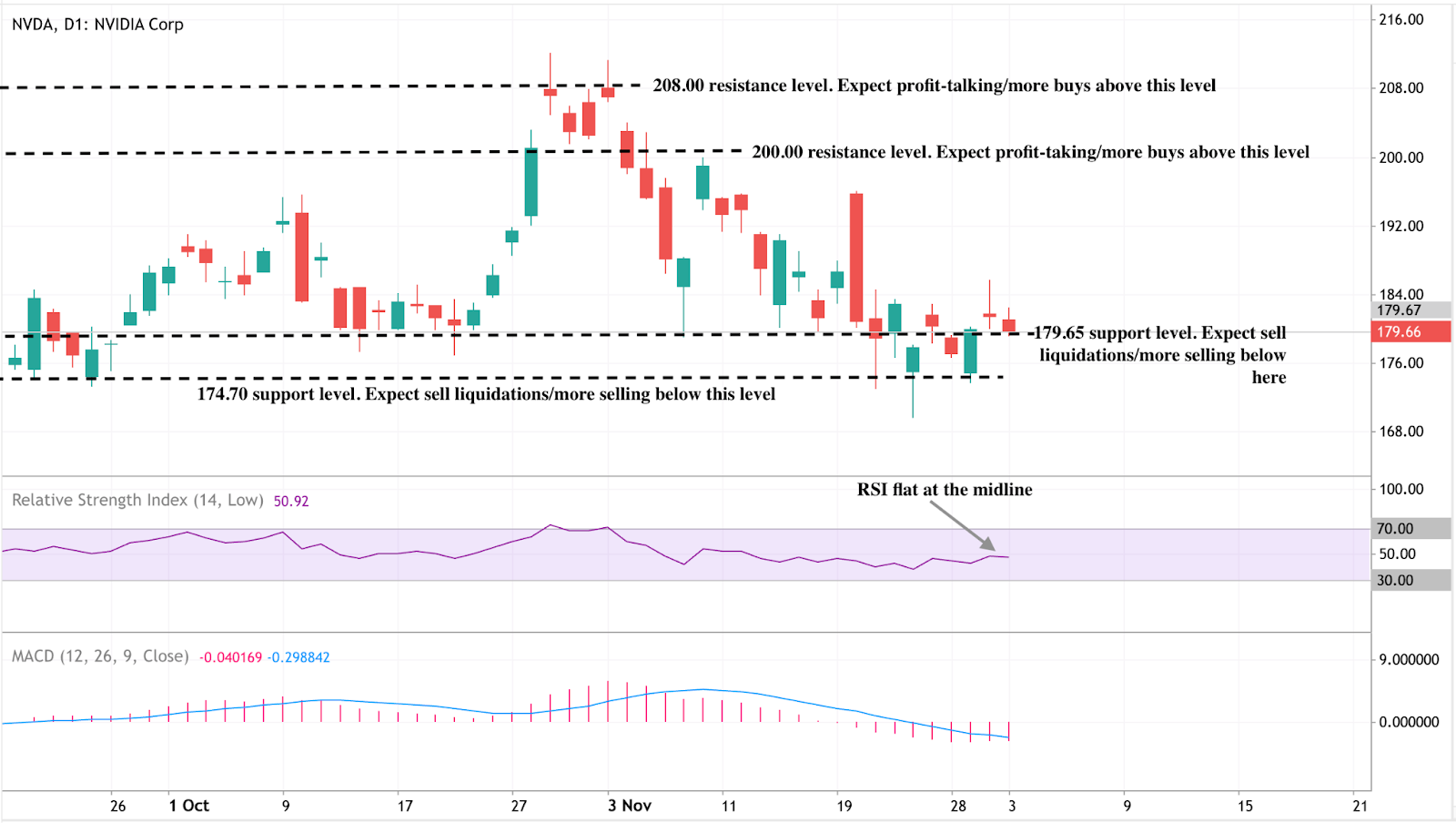
At the start of writing, NVIDIA (NVDA) is trading around $179.66, holding just above the immediate $179.65 support zone. A break below this level could trigger sell liquidations and expose the next major support at $174.70. On the upside, the price faces two key resistance levels at $200.00 and $208.00, both zones where traders may begin to take profits, although a strong breakout above either would signal renewed bullish momentum.
Recent price action reflects hesitation, with candles clustering tightly and volatility narrowing. This signals that NVDA is waiting for a catalyst - likely a macroeconomic data release or a shift in tech-sector sentiment - to dictate its next direction.
Momentum indicators also highlight the indecision. The RSI is flat at the midline around 51, indicating neutral sentiment with neither bulls nor bears in clear control. Meanwhile, the MACD histogram remains negative, although the bars are gradually shortening, suggesting a potential shift toward bullish momentum if buying pressure increases. Overall, NVDA sits at a crossroads, with upcoming moves in tech likely to determine whether it retests resistance or slides toward support.
The performance figures quoted are not a guarantee of future performance.


