Why Bitcoin’s latest drop signals a shift in market control

February 4, 2026
Bitcoin coins suspended mid-air as they fall between two modern concrete buildings.

Bitcoin’s latest slide is not just about falling prices - it reflects a clear change in who controls the market. Data showed that the world’s largest cryptocurrency has dropped more than 40% from its October high above $126,000 and briefly fell below $73,000 this week, its lowest level since November 2024. 

Crucially, bitcoin has now slipped below its True Market Mean Price, according to analysts, a valuation threshold that historically separates bull-led markets from bear-dominated ones.

This breakdown comes as global investors retreat from risk amid AI-driven equity sell-offs and rising geopolitical tensions. With gold surging nearly 7% in a single session and volatility climbing across asset classes, bitcoin’s behaviour suggests that market leadership is shifting away from buyers and towards sellers - a transition that could shape price action for months ahead.

What’s driving Bitcoin’s latest drop?

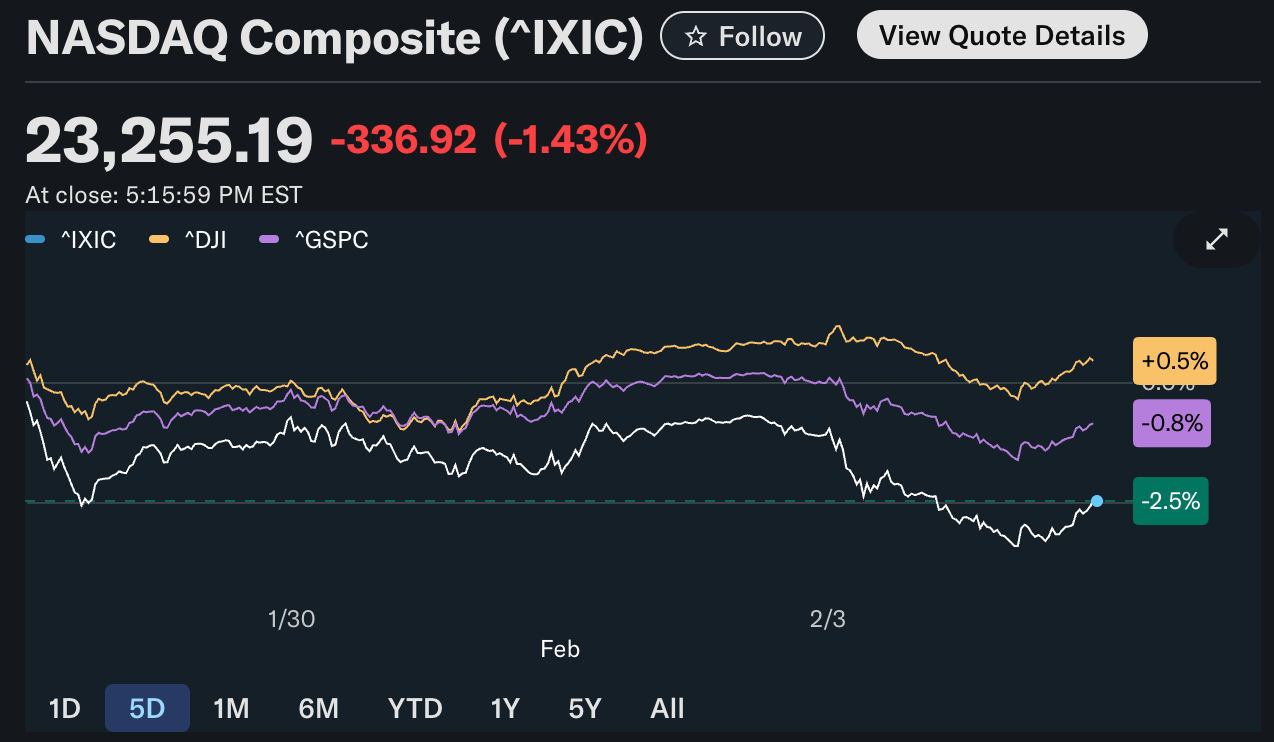
Bitcoin’s decline has unfolded alongside a broader risk-off move across financial markets. US equities stumbled as confidence in the artificial intelligence trade weakened, with the Nasdaq falling 1.4% and major technology stocks selling off sharply. 

NASDAQ Composite chart showing recent losses compared with the Dow Jones and S&P 500.
Source: Yahoo Finance

Disappointing cloud growth from Microsoft, combined with rising AI investment costs, reignited concerns that valuations across the tech sector had run ahead of sustainable profits.

As equities fell, speculative assets followed suit. Bitcoin traded in lockstep with high-beta technology stocks rather than serving as a hedge, reinforcing its sensitivity to liquidity conditions. When investors reduce risk exposure, bitcoin often absorbs outsized losses, particularly during periods when leverage remains elevated across crypto derivatives markets.

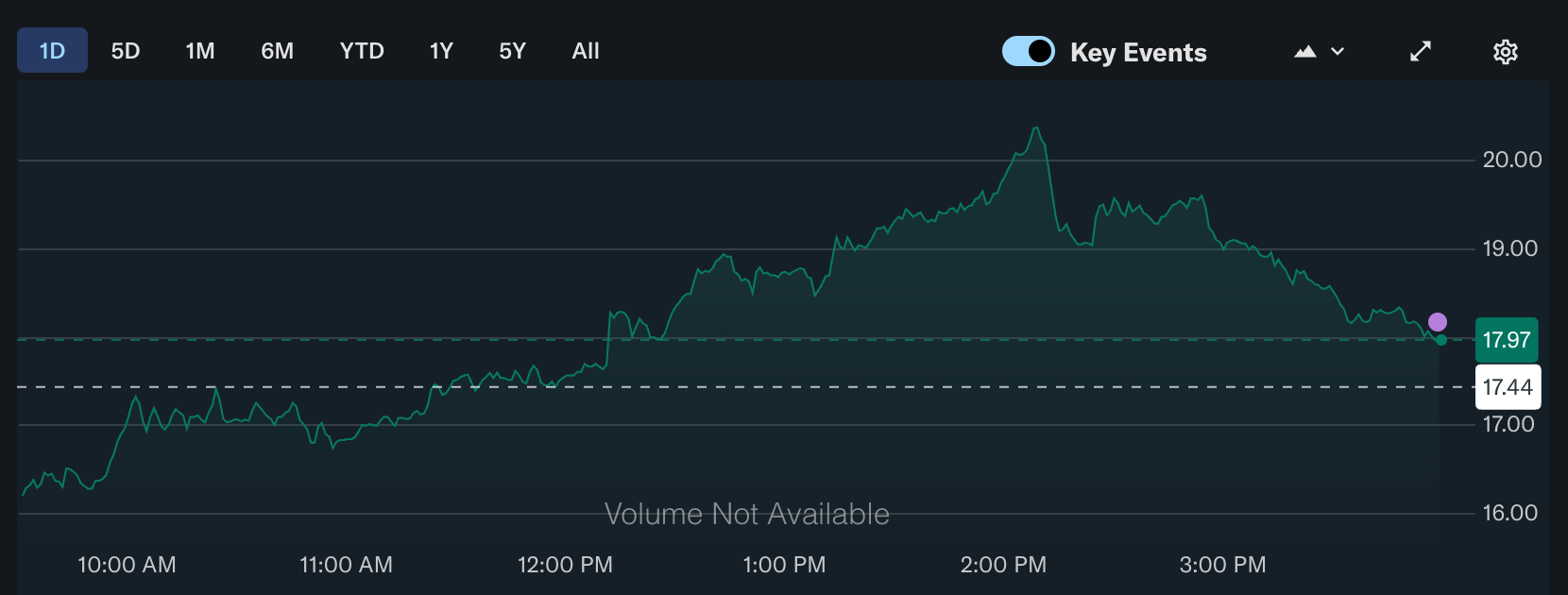
Geopolitical developments compounded the pressure. Reports that the US shot down an Iranian drone near a US aircraft carrier pushed the VIX volatility index briefly above 20, a level associated with heightened market stress. 

Intraday price chart showing a rise followed by a late-session pullback.
Source: Yahoo Finance

Capital rotated rapidly into traditional safe havens, with gold and silver posting double-digit moves over the week, leaving bitcoin on the wrong side of defensive positioning.

Why it matters: A break below the true market mean

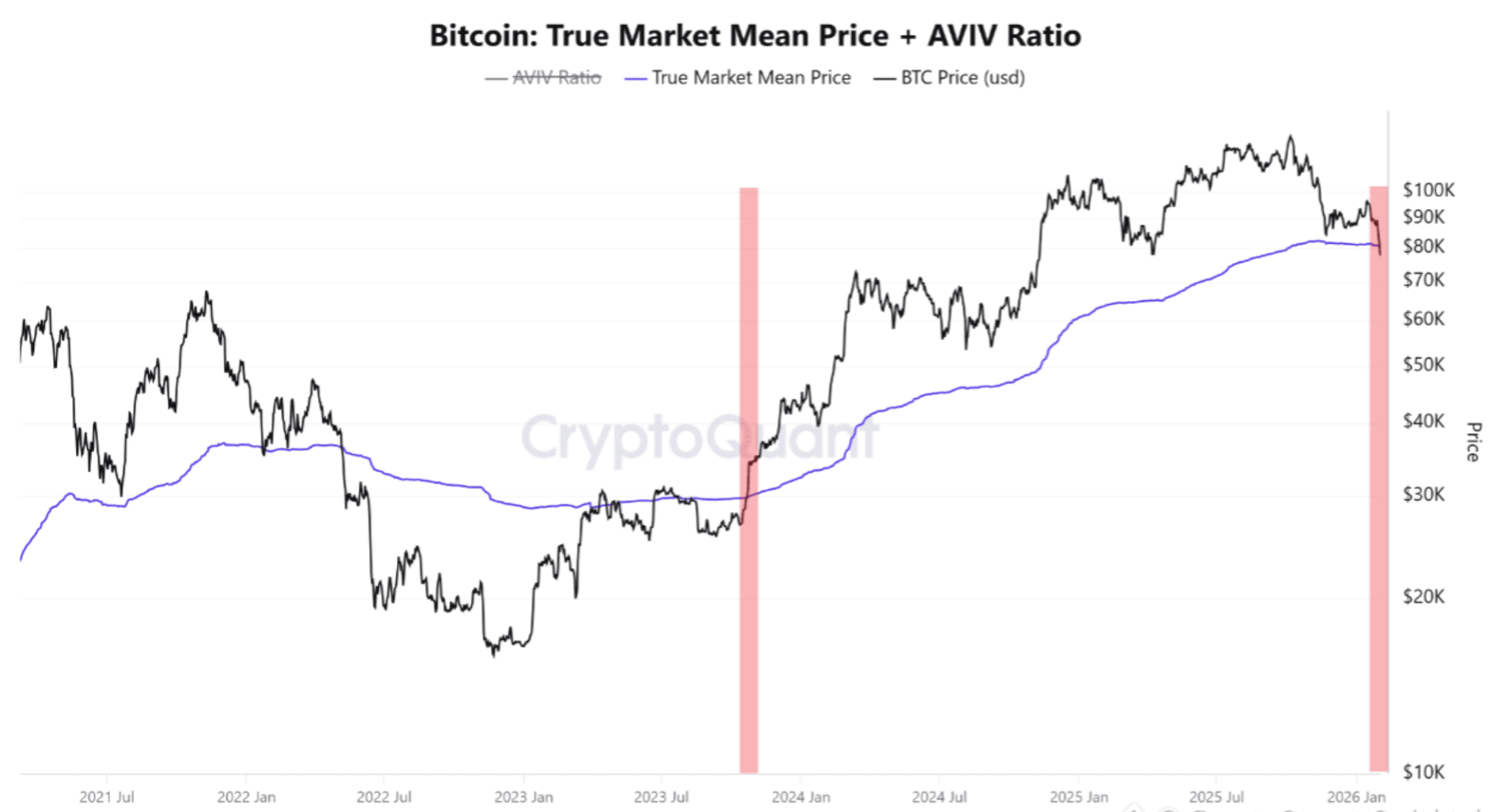
The most important signal from this move is bitcoin’s fall below its True Market Mean Price, currently estimated near $80,000. 

Bitcoin price chart comparing market price with the True Market Mean, highlighting periods of market stress.
Source: CryptoQuant

This metric reflects the average historical cost basis of all bitcoin holders and is widely used to assess whether the majority of investors are in profit or loss. When prices remain above this level, buyers typically retain control. When prices fall below it, selling pressure often intensifies.

In previous cycles, this shift has marked a change in market regime. During the 2022 downturn, bitcoin’s weekly close below the same metric preceded a seven-month decline that eventually pushed prices down by more than 55%. While current conditions differ, the behavioural response is similar: underwater holders become more inclined to sell rallies, limiting upside momentum.

Gerry O’Shea, head of global market insights at Hashdex, highlighted that bitcoin’s divergence from gold reflects how investors currently perceive risk. Gold has now outperformed bitcoin over the past five years, signalling that markets continue to favour established stores of value during periods of macro uncertainty. That shift in preference matters when assessing who holds pricing power.

Impact on crypto markets and investors

The immediate impact has been visible across the crypto market. Bitcoin’s sharp intraday drop triggered liquidations across leveraged positions, accelerating downside moves and dragging major altcoins lower. When market control shifts towards sellers, volatility tends to rise as thin liquidity amplifies price swings.

For retail investors, the implications are more structural. Many participants entered during the late-2024 rally, meaning a growing share of holders are now sitting on unrealised losses. Historically, this reduces risk appetite and delays recoveries, as confidence takes time to rebuild. Institutional flows have also become more selective, with investors favouring commodities and defensive assets over digital currencies in the current environment.

Expert outlook: What happens next

Looking ahead, analysts expect bitcoin to remain volatile as the market searches for a new equilibrium. Regulatory uncertainty, macroeconomic instability, and tightening financial conditions all limit the likelihood of a rapid rebound. O’Shea expects near-term turbulence to persist as crypto continues to integrate into mainstream financial infrastructure, even as long-term adoption trends remain intact.

History suggests that breaks below key valuation metrics rarely resolve quickly. Instead, markets often enter a prolonged phase of consolidation or gradual decline as weaker hands exit and stronger holders accumulate. Over the next three to six months, bitcoin’s ability to reclaim the $80,000 level will be closely watched as a signal of whether buyers can regain control or whether the balance of power remains firmly with sellers.

Key takeaway

Bitcoin’s latest drop signals more than short-term weakness - it points to a shift in market control away from buyers and towards sellers. As risk appetite fades across global markets, crypto is behaving less like a hedge and more like a speculative asset. The next few months will likely define whether this move becomes a prolonged reset or a base for recovery. For now, patience and risk awareness remain critical.

Bitcoin technical outlook

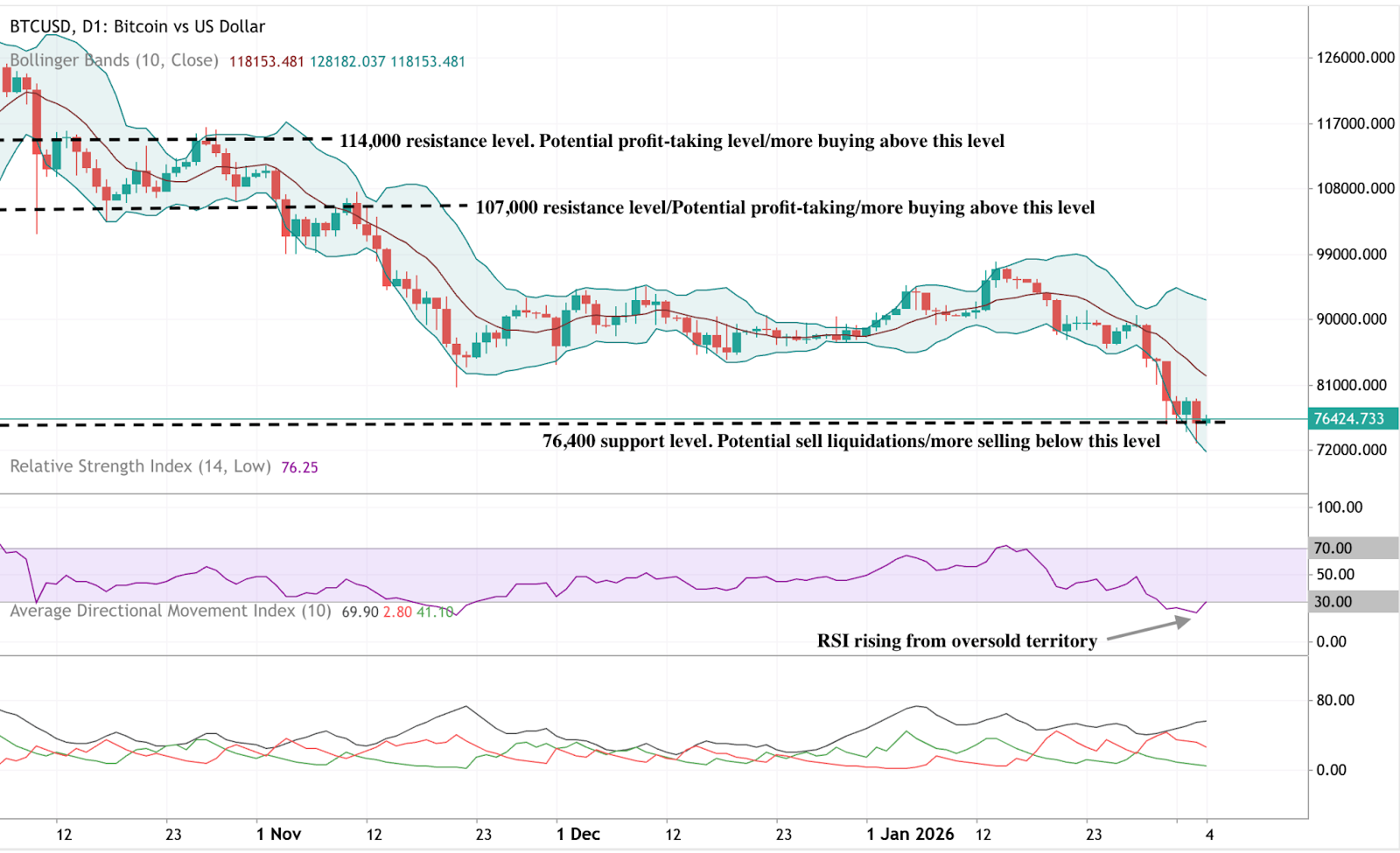
Bitcoin has continued to move lower within its broader structure, with the price dipping below the lower Bollinger Band before stabilising near $76,400. The Bollinger Bands remain widely expanded, indicating that volatility is still elevated following the recent downside acceleration.

Momentum indicators show early signs of stabilisation: the RSI has begun to rise from oversold territory, reflecting a moderation in downside momentum after the sharp decline. Trend strength remains high, with ADX readings elevated, pointing to an active and mature trend environment despite the recent loss of directional momentum. 

Structurally, price is now positioned well below the former resistance zones around $90,000, $107,000, and $114,000, highlighting the extent of the preceding move. 

Daily Bitcoin price chart showing a sharp decline toward support near 76,400, followed by early signs of stabilisation.
Source: Deriv MT5

자주 묻는 질문

왜 비트코인은 하락하고 금은 오르고 있을까요?

금은 지정학적 및 경제적 불확실성 시기에 오랜 기간 안전자산으로서의 역할을 해왔기 때문에 이익을 얻습니다. 비트코인은 “디지털 금”이라는 내러티브에도 불구하고, 시장에 스트레스가 가해지는 시기에는 여전히 위험자산으로 취급받고 있습니다.

진정한 시장 평균가 이하로 하락하면 무엇을 의미하나요?

이는 평균 비트코인 보유자가 현재 손실 상태임을 시사하며, 이는 종종 매도 압력 증가와 랠리 시 수요 약화로 이어집니다.

이것이 비트코인이 약세장에 진입했다는 의미인가요?

애널리스트들에 따르면 반드시 그렇다고 할 수는 없지만, 이 수준 아래에서의 지속적인 거래는 역사적으로 약세장 조건과 일치해왔습니다. 확정 여부는 앞으로 몇 달간의 가격 움직임에 달려 있습니다.

이 단계는 얼마나 오래 지속될 수 있을까요?

과거 사이클을 보면 유사한 기간이 몇 달 동안 지속되었습니다. 현재 애널리스트들은 올해 상반기 동안 높은 변동성과 조정 국면이 이어질 것으로 예상하고 있습니다.

콘텐츠