Why Gold’s $4,800 breakout may not be the peak

January 21, 2026
A metal balance beam tilted downward under the weight of a red oil barrel with a globe symbol.

Gold’s surge beyond $4,800 an ounce has been widely framed as a record-breaking moment. That description is accurate, but incomplete, according to some analysts. Prices have climbed more than 5% in a single week, a move that coincided with sharp shifts in currencies, bonds, and investor behaviour rather than any single economic data point. This was not a rally driven solely by inflation fears.

Instead, gold’s breakout reflects a deeper repricing of political risk, global trust, and capital safety. As tensions between the United States and Europe escalate over Greenland and trade policy, investors are reassessing where stability truly resides. In that context, $4,800 may prove less like a peak and more like a new reference point.

What’s driving Gold’s breakout?

The immediate catalyst has been a sharp rise in geopolitical risk centred on the Arctic and transatlantic trade relations. U.S. President Donald Trump’s insistence that there is “no going back” on Greenland, coupled with threats of tariffs on eight European countries, injected uncertainty into markets already sensitive to political shocks. European leaders pushed back forcefully, with French President Emmanuel Macron warning against coercion and signalling potential retaliation.

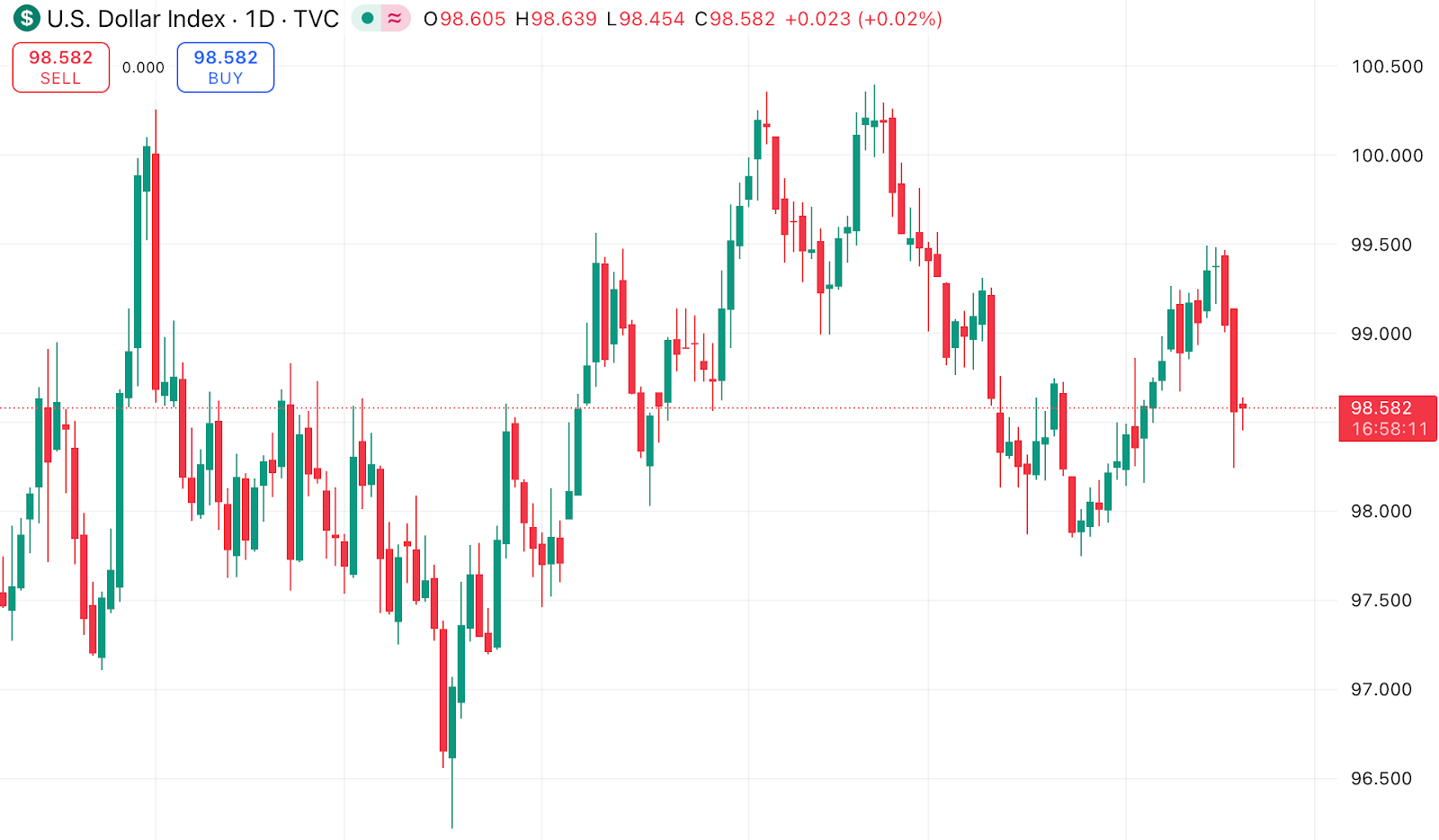
Markets reacted not to rhetoric alone, but to the implications for alliances and capital flows. The U.S. Dollar Index fell nearly 1%, marking its steepest decline since April, while U.S. bond prices slid and yields spiked. 

Daily candlestick chart of the U.S. Dollar Index showing short-term fluctuations between roughly 97.0 and 100.5, with recent price action consolidating near 98.6 in late January 2026.
Source: TradingView

The euro strengthened, and European officials reportedly discussed suspending approval of a U.S. trade deal agreed last year. In that environment, gold benefited from being neither a currency nor a sovereign liability.

Monetary policy has played a secondary role. Strong U.S. labour data pushed expectations for the next Federal Reserve rate cut back to June, reinforcing the “higher for longer” narrative. Ordinarily, that would weigh on gold. This time, political risk overwhelmed rate dynamics, underscoring how the metal’s function is shifting from inflation hedge to geopolitical insurance.

Why it matters

Gold’s rally matters because it signals a broader erosion of confidence in traditional safe havens. The latest move coincided with what traders openly described as a “sell America” trade, as global investors reduced exposure to U.S.-centric assets. Krishna Guha of Evercore ISI described the environment as a “much broader global risk-off,” driven by political uncertainty rather than economic slowdown.

Ray Dalio framed the issue even more starkly at the World Economic Forum in Davos. He warned that trade conflicts can morph into capital wars, in which countries reassess their willingness to finance U.S. deficits or to accumulate U.S. debt. Gold’s surge reflects that concern. When trust in financial leadership weakens, neutrality commands a premium.

This shift challenges the long-held assumption that government bonds are the ultimate refuge. Rising debt levels, political polarisation, and strategic rivalry have diluted that role. Gold’s breakout suggests investors are redefining what safety looks like in a fragmented world.

Impact on markets and investors

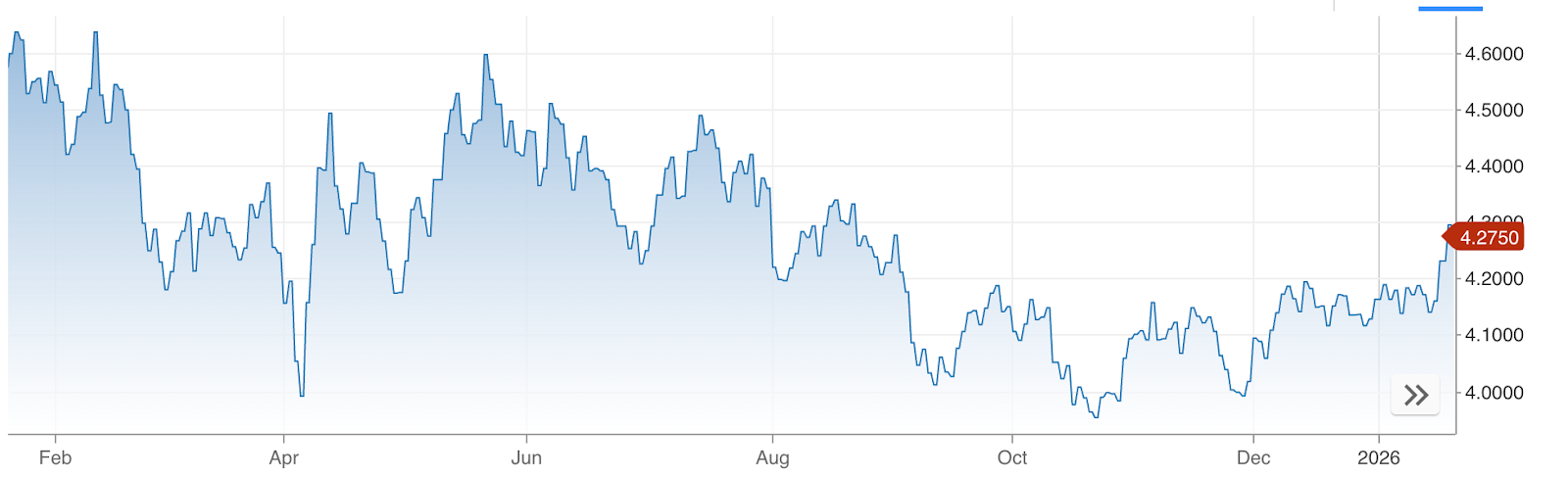
The effects have rippled across asset classes. Precious metals broadly advanced, with silver also hitting fresh highs. Equity markets reacted unevenly, with mining stocks benefiting while sectors exposed to trade disruptions lagged. Bond markets told a clearer story, with higher yields signalling capital exiting U.S. fixed income rather than rotating within it.

Line chart showing a market interest rate fluctuating between roughly 4.0 and 4.6 over 2025, with a decline into October followed by a rebound
Source: CNBC

Currency volatility reinforced gold’s momentum. The dollar’s sharp drop amplified the metal’s appeal, creating a feedback loop that historically accompanies major gold advances. When currencies wobble, gold often serves as a benchmark that sits outside central bank influence.

Institutional demand adds another layer of support. Central banks have steadily increased gold reserves in recent years as part of diversification strategies. That accumulation suggests this rally is not driven solely by speculative excess, but by long-term allocation decisions that tend to persist even after volatility fades.

Expert outlook

Whether gold extends its rally from here remains debated. Some analysts expect consolidation after such a rapid move, especially if diplomatic tensions cool or currency markets stabilise. Others argue that meaningful peaks usually coincide with resolution, not escalation, and little about the current geopolitical backdrop points to resolution.

One senior precious-metals strategist described the move as a “structural repricing driven by geopolitics and confidence shifts rather than short-term fear.” That view implies that former resistance levels may now act as psychological support. If geopolitical tension, fiscal pressure, and alliance uncertainty persist, gold’s role in portfolios is likely to expand further.

Markets will be watching developments around U.S.–EU relations, trade policy, and central bank reserve behaviour closely. These signals, rather than day-to-day price swings, will determine whether $4,800 marks the end of a range or merely the start of a higher one.

Key takeaway

Gold’s break above $4,800 reflects more than a rush to safety. It signals a reassessment of political risk, currency stability, and global trust. With central bank demand underpinning prices and geopolitical tension unresolved, this move may represent a new baseline rather than a blow-off top. What happens next will depend less on economic data and more on diplomacy, trade, and confidence in global leadership.

Gold technical outlook

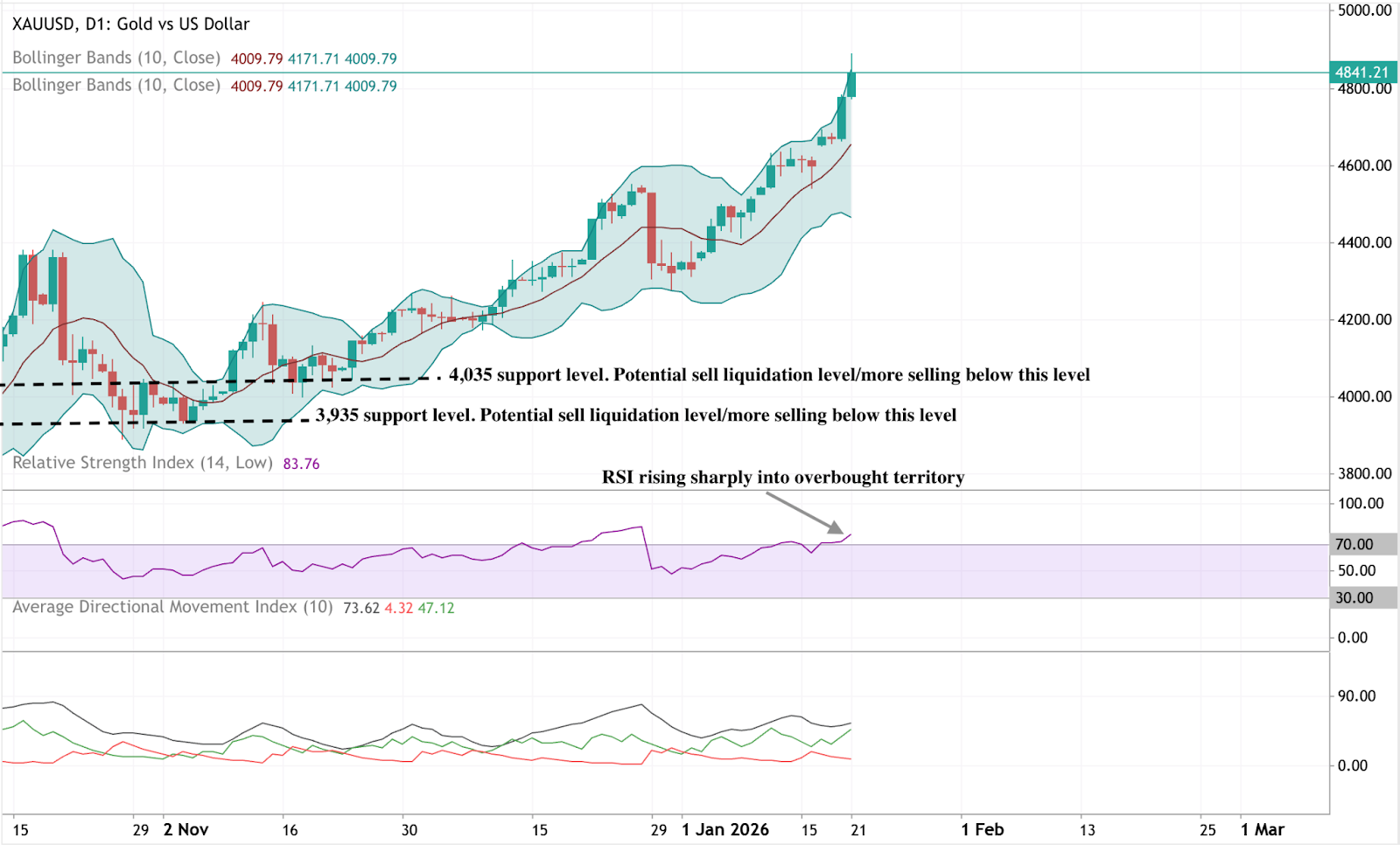
Gold has pushed into fresh all-time highs past $4,800, trading beyond the upper Bollinger Band and signalling an extreme momentum phase. Volatility remains elevated, with the bands widely expanded, reflecting sustained directional pressure rather than consolidation. 

Momentum indicators are deeply stretched, with the RSI overbought across multiple timeframes and the monthly reading near extreme levels, while the ADX above 30 confirms a strong, mature trend environment. Overall, price action reflects active price discovery, where trend strength and exhaustion risk are coexisting features of the current market structure.

Daily chart of gold versus the US dollar (XAU/USD) showing a strong bullish breakout above 4,800, with price riding the upper Bollinger Band.
Source: Deriv MT5

The information contained on the Deriv Blog is for educational purposes only and is not intended as financial or investment advice. The information may become outdated, and some products or platforms mentioned may no longer be offered. We recommend you do your own research before making any trading decisions." is present

자주 묻는 질문

No items found.
콘텐츠